

Tiara Today
Tiara: The New Quality Leader?
by David Pascoe
We've always liked Tiara and Pursuit boats, both products of S2 Yachts of Holland, Michigan. In times past we've recommended them as good, solid quality, well-designed boats that are a bit more utilitarian than glitzy. The kind of boat that holds up well to year 'round use under the blazing Florida sun, as well as the five month monsoon season that can dump 80" of rain on your boat annually.
One of the things I've always liked about them was how they restrained themselves from loading their boats up with cheap hardware and other gratuitous junk just to give you the appearance of getting more. No plastic hardware to turn black with mildew, or to disintegrate from sunlight. No die cast zinc alloy or crummy aluminum.
Naturally, as surveyors, our primary business is with used boats, so we are usually several years behind the times on new models. Thus, it was several years ago that we began to notice a change in Tiara. For one thing, they started making an appeal to the high end sport fishing market. Whereas boats like the 3600 Open had rather plane-Jane cockpits, now we started seeing things like built in bait wells, tackle centers, rod storage lockers, Rybovich style hull vents and all those kind of goodies. Keeping up with the sport fishing Joneses as it were.
But the sport fishing market is a rather limited one, and so Tiara has wisely taken their "open" line of models and created both dedicated fishermen and cruisers. The primary difference of the two being the amount of seating and lack of obstructions in the cockpit areas for the fishermen.
Most recently we were assigned the task of looking over three brand new Tiaras. Now we get to see up close and personal what we'd previously been seeing only from a distance. Without question, Tiara has raised the quality a notch or two. Which, of course, means that the price tag has gone up along with it. That should go without saying. Want good? Gotta pay for it. We can say without reservation that, for the price, what you are getting is not a snow job, not some marketing ploy to sell you something that looks good today, but turns to dust tomorrow. No, these boats have some bone deep quality in them.
First off, we got to compare the 35 Open with the 4100. As is common in the industry, the overall quality tends to go up with the size and price of the boat, and that is clearly the case here. With the 4300 Open, Tiara is clearly taking a shot at Viking and Hatteras, with all the latest design, quality and style features to match. As for Hatteras, they seem too busy with their mega yacht business to bother with the little guys. Can't remember when we last looked at a late model under 50 feet.
The interior of the 4300 is a real eye-catcher. Done out all in teak (Gasp! Dark wood!) it is positively scrumptious. I wish a picture could tell the story, but it really can't. The last time we raved about quality wood work was on the 1997 Viking 43 SF which had less of it, but better overall quality. Frankly, I'm glad to see teak interiors making a come back. Why? For one thing, it is durable. If you screw it all up, the finish can be restored. Not so with light color woods like ash, oak and maple that get permanently stained.
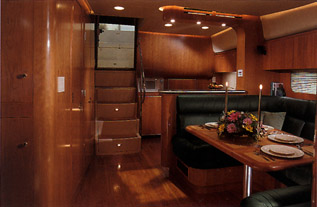
The 4300 Open. No pretense at luxury here, it looks better live than this photo.
Up north, where the sun doesn't shine that much, dark interiors are understandably unpopular. But here in the tropics, sunny days can get just as boring -- not to mention the blinding light, heat and carcinoma that it causes -- so popping down into your deep dark abode immediately renders a sense of soothing coolness, away from the glare and shutting out the rest of the world. If you like that sort of atmosphere, you'll love this one. And it is decidedly masculine. No red or green leather and brass, but you can get teal. Close enough. Spittoons and cigar clippers are optional, for those of you who defy convention and love your Monte Chistos and La Habanas. Easy clean vinyl headliner if you're into the soothing effects of tobacco.
With the 4300, start with a beveled edge, tongue-and-groove teak planked sole with holly stepping. Not the most practical design in terms of keeping dirt out of the cracks, but boy it sure looks great. The sculptured effect is immediately obvious and exudes an amazing sense of quality. Then we've got a fold up dinette table with round, solid teak edge banding a good 2" thick with 180 degree round over; joiner work is first class.
The 3500 had a limed ash or oak interior that was nice, but the veneers weren't the best, nor was the joiner work really great. There were cabinets and drawers veneer faced with veneer edge banding that left very hard corners and a failure to give the impression of great workmanship. Nice, but not impressive to those who recognize quality; the finish on the wood was also thin. Contrasting this with the 4300, where we find a lot more rounding, the finish is obviously well done. So what's the big deal with rounding? Well, for one thing square is cheaper to make than round. Secondly, I'd much rather bump into a rounded corner than a sharp one. I got enough scars on my body. But the finish on the woods is clearly better than the 3500, giving the impression (whether it is or not) of overall higher quality and better workmanship.
The overall design, selection of materials and color scheme is superb. Everything is mute without appearing dull. Color freaks won't care for this, but when it comes to a yacht, it's foolish to stray into the realm of the trendy or flashy. Gotta think about resale; if it's loud, it gets hard to sell when the flavor of the day constantly changes. The color schemes used here are timeless and will not go out of style. Call it subdued good taste. Smart money stays conservative. Moreover, the use of foam padded vinyl is kept to a merciful minimum and you're new Tiara won't smell like like a vinyl factory; instead, it smells like wood.
Full, fiberglass liners make our day for the head compartments, with hose-down ease of cleaning on the smaller models, stall showers on the larger. While the galley on the 3500 resembles more closely a sandwich board, on the 37 and up, they're darn nice, although having wood cabinets directly above a pot of boiling water doesn't make good sense. Yet in all models, the amount of storage space is more than adequate, plus sensibly designed with spaces to store pots as well as dishes without any contortionist exercises.
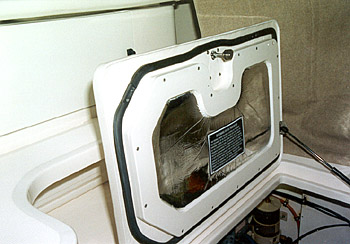
The trained eye can't fail but to notice the detail work on this hatch cover. Have you had enough of glued-on insulation falling off? That's not going to happen with this one.
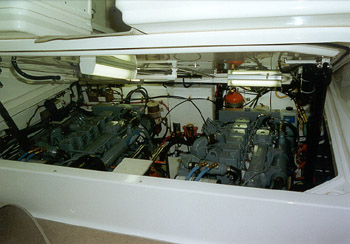
Even though a bit too much is crammed into this 3500 engine compartment, it's hard not to be impressed by the high quality detail work, starting with fluorescent lighting and the deep hatch gutters to keep water out.
As a true sport fisherman, both the 35 and 43 flunk the test by virtue of cockpits compromised for the cocktail crowd. There is altogether too much upholstery and obstructions for those who are going to give a cockpit a lot of hard use. Some of this glitz is optional, so you'll need to check on how much can be eliminated from the show models. On the 35, the large, L-shaped settee at forward cockpit creates a serious traffic bottle neck, leaving only a 14" wide walk thru. Along with a hinged, pneumatically operated rear seat, there are too many obstructions. For sports-minded people, for the outdoorsy types, the last thing you want is clutter in the cockpit; that's for the cocktail cruisers where seating a lot of people is the primary requirement.
On attention to design detail, we're getting close to as good as it gets. I'm talking about things like:
- Whether salt water is going to leak all over your engines and machinery when you go to sea. Or when you hit the deck with a hose to wash it. Take a look at the hatch design detail in the nearby photo. A hatch like that probably costs 4X what the run of the mill hatch would cost. Notice that the insulation is not just glued on so that it's going to fall off in a few years. And that you can take the underliner off in order to replace the insulation when it gets all tore up, as it inevitably will.
- Hatch gutters: The gutters on the electrically lifted large hatch section are very large and deep. The drains are 2" diameter so they won't clog up easily. Know what happens when an improperly designed drainage system gets clogged up? Yep, the water overflows and onto tens of thousands of dollars worth of machinery. If you wonder why we ridicule bad design, that's it.
- Details like the hatch and cabinet doors are thru-bolted, not screwed into fiberglass.
- Details like the transom door hinges are double thick stainless with an adequately constructed jamb so the whole arrangement isn't going to break apart from the tremendous leverage applied by the door.
- Details like proper rounding of fiberglass moldings so they don't fracture at sharp angles.
- Details like gaskets and strong dogs on all hatches.
- Overall better quality hardware.
- A properly constructed hull/deck joint and rub rails so that 5 years from the time you write the check, the side of your boat doesn't look like it went through a hurricane
- Strong windshields with base gutters to drain off the inevitable leakage.
- Well laid out electric panels. Various other switches and panels aren't scattered all over the place. For example, on one new boat we recently looked at, we found electrical controls in five different locations, taking a good hour just to figure out where things were and how they operated. On these boats, everything is instantly clear; never spent more than a minute looking for a switch.
The day prior to writing this, I did a survey on a 36 footer that had the electric panel crunched between the helm and the cabin side, literally at floor level. Had to get on my hands and knees to operate a switch. How on earth could anyone tolerate such a thing, I wondered. I mean, is it someone's idea of great fun to have to stand on your head to read a volt meter or throw a switch? Talk about a designer with his head up his ass. Where are the panels on a Tiara? At eye level where they should be.
I could go on and on, but you get the picture. Real quality is not only in materials but in the design details, all of which make ownership and operation of the vessel far 6easier and less costly, often requiring you pay for things once, rather than twice or three times.
The engine compartments on all the Tiaras were something of a let down. Not that they're not loaded with good quality stuff, but like a Sea Ray, not much thought was given to how anyone is going to reach a lot of stuff for repair or service. If you're a do-it-yourselfer, this has got to give you a pause for consideration. Even with the opening full deck section, things are still hard to reach, yet it's hard not to be impressed with the quality.
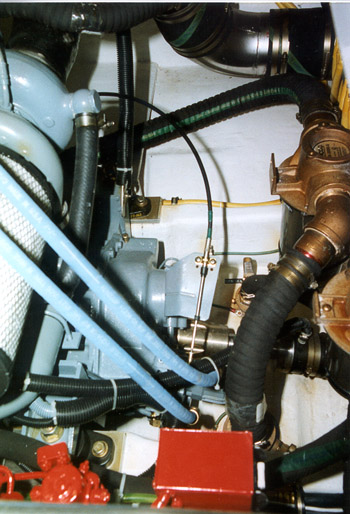
The down side on the smaller models. Some engine compartments that can be pretty cramped. It's extremely hard to reach anything. That's the transmission down there.
As you can see in the photo above, there's a nice, easy-clean glass headliner, along with fluorescent lighting so at least you can see what you're doing. The problem is simply too much in too small a space. You got your nice big cabin and cockpit, but this is the price you pay for that.
But you'll find other great features like the cabin door on really good rollers and also with a sliding screen. Both slide as easy as can be. And the electrically opened center windshield is another nice feature. So too is the manner in which the Bimini top is fitted to the windshield; it has only an 8" high eisenglass zippered section that is easy to open to let the air through. Neat.
I also like the heavily rounded toe rails with at least a 4" radius. Not only does this look good, but it makes the gunwale stronger and much less prone to stress cracking when you really bang against a piling.
Another real strong point is the ergonomics of the helm which I found superb, particularly with an electrically operated helm seat. Of course, this is just another electric gizmo to crap out on you, but like electric seats in a car, it is a nice feature. However, if you like to sit and steer with your hands, forget it. This is one for sitting back and steering with your feet, which is my usual method.
One thing Tiara did that is a real head scratcher is that they made the deck up under the windshield black. I don't think I need explain why that is not good for a variety of reasons.
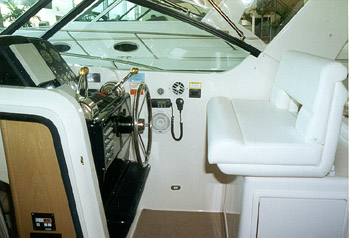
The helm designs are generally superb. This is the 3500 with a power seat.
Easy boarding. Some of the cockpit designs we've seen lately are truly atrocious. It's hard to image that a designer figures that you could tolerate only boarding over the transom, or having to climb all over the upholstered seating -- or worse yet -- walking across a wet bar. But they do. The 3500 has a built-in step each side, which is completely out of the way so you don't get to trip over it, and immediately behind the arch where there is a handy grab rail. And with that pointed diamond non-skid pattern, there's no chance of slipping and getting your bones rearranged. Even Grandma could board with relative ease. But, if you like to mimic the Europeans, who apparently don't have many docks, she's got a 30" wide platform that is removable. It looks like it's integral, but it's not.
Aside from the upholstery, there isn't much in the cockpit area to go to rot and ruin. The little wet bar has a heavily rounded, deep lid with no steel hardware and not much else. Apparently Tiara designers know that salt water comes cascading over the bow to frequently douse the cockpit with that wonderfully corrosive fluid. If stuff can't withstand salt water, it shouldn't be on a boat. In this case, it isn't. Plus you may think that the windshield is ungainly high -- would you like to have a nice, sleek, low Euro style windshield. Well, just keep in mind that the high windshield keeps salt spray off most of your goodies at the helm. Euro style is great in the showroom but it sucks canal water in out here in the real world.
Summing Up
Clearly Tiara is taking a run at being the quality leader. Equally clear is that they're getting close, particularly with the smaller models. In the forty foot range, the engine rooms are a bit of a disappointment and don't measure up to Hatteras or Viking, the later of which has the best machinery installations of any production builder.
If you're not an aficionado, this won't much matter to you. But for today's yachtsmen, a well designed and gleaming machinery space ranks just as high as the exterior appearance, a throwback to our early days of hot-rodding and chrome plating everything. Half the fun of ownership is show-and-tell, like cruising the burger stand on Friday night and opening your hood for all to see. Hey, buddy, whatcha got in there? My Awlgripped, chrome plated 8V92, turbocharged, after burner Dee Twa Diesels, man. The ones with the 250 cc injectors, man. Good for one weeks fishin' and then rebuild 'em. Divorced the wife, bought a boat. A hot rod boat, that is. And why the heck not? Nobody makes a car these days anyone could have an ounce of pride in owning. They're all the same plastic junk. Not even a spot of chrome left on a Jaguar, for God's sake.
It's an injection molded, throw-away, plastic world out there folks. Boats like these represent the last of the world of quality and pride in ownership in something that is mass produced. For those who can afford it.
For the time being, for production builders who turn out a lot of boats, I'll give Tiara the number two spot behind Viking.
See ya at Walker's, chum. Wanna race?
Posted May 20, 1999
-
Boat Reviews Articles
At-A-Glance - Introduction to Boat Reviews
- A
- Albemarle 305
- Aquasport 215
- B
- Baha 260 Targa (not "Baja")
- Bertram Yachts
- Bertram Yachts: Introduction
- Bertram 26.6 II
- Bertram 28 II
- Bertram 30 Express
- Bertram 30 Moppie
- Bertram 31 SF
- Bertram 33 SF
- Bertram 36 Moppie
- Bertram 42 Convertible
- Bertram 46 Convertible
- Blackfin Yachts
- Blackfin 29 SF
- Blackfin 29 Combi
- Blackfin 32 Flybridge
- Blackfin 33
- Boston Whaler Outrage 26
- C
- Cabo 31 Sport Express
- Carver 370
- Century 3000
- Chris-Craft 302 Crown
- Contender 25
- Cranchi Mediterranee 40
- Cruisers 4270 Esprit
- Cruisers 4280
- G
- Glacier Bay 2640 Renegade
- Grady-White Offshore 24
- Grady-White 24 Voyager
- Grady White 272 Sailfish

- Grand Banks 42
- Gulfstar 43 Trawler-style Yacht
- H
- Hatteras Yachts
- Hatteras Yachts: Introduction
- Hatteras 36 Convertible
- Hatteras 38 Convertible
- Hatteras 38 Convertible - Updated Review
- Hatteras 39 Sport Express
- Hatteras 45 Convertible
- Hatteras 52 Convertible
- Hatteras 53 Motor Yacht & Convertible
- Hatteras 61 Motor Yacht
- Hunter 28
- Hyatt 45 CMY
- I
- Intrepid 289
- Island Gypsy 40
- L
- Lafitte 44
- Legacy 34 Express
- Luhrs 320 Open
- Luhrs 34 - 340 F.B. Sedan
- Luhrs Tournament 350
- Luhrs Tournament 360
- M
- Mainship 31
- Mainship 350 Trawler
- Mako 221- Updated 11/05/99
- Mako 26
- Maxum 4600 1998
- Mochi 50
- Morgan 462 Ketch
- O
- Offshore 48
- P
- Post 46 Convertible
- Pursuit 2855
- Pursuit 3000 Offshore
- Pursuit 3070 CC
- S
- Sea Ray
- Sea Ray and Balsa Core Bottoms (from "Structural Issues")
- Sea Ray 250 Sundancer
- Sea Ray 27
- Sea Ray Sundancer 290
- Sea Say Sundancer 290 Update
- Sea Ray 370 AC
- Sea Ray 39 Express
- Sea Ray 500
- Sea Ray 55
- Shamrock 26
- T
- Thompson Santa Cruz 2700
- Tiara 2700
- Tiara 3100 Open
- Tiara 3600 Convertible
- Tiara 3600 Open
- Topaz 28_1981
- Trojan 10-8 Meter
- Trojan 14 Meter Convertible
- Trojan 440 Express
- V
- Viking 43 Open
- from other cat.
- Marlin Monroe
42 Bertram Convertible
Make an Old Boat New - Tiara Today
The New Quality Leader?
Articles at
docksidereports.com




David Pascoe's
Power Boat Books
 Mid Size Power Boats
A Guide for Discriminating Buyers
Focuses exclusively cruiser class generally 30-55 feet
With discussions on the pros and cons of each type: Expresses, trawlers, motor yachts, multi purpose types, sportfishermen and sedan cruisers.

Selecting and Evaluating New and Used Boats
Dedicated for offshore outboard boats
A hard and realistic look at the marine market place and delves into issues of boat quality and durability that most other marine writers are unwilling to touch.
2nd Edition
The Art of Pre-Purchase Survey The very first of its kind, this book provides the essentials that every novice needs to know, as well as a wealth of esoteric details.
Pleasure crafts investigations to court testimony The first and only book of its kind on the subject of investigating pleasure craft casualties and other issues.

- Chapter 1
- Basic Considerations
- Chapter 2
- Boat Types: Which is Right for You?
- Chapter 3
- Old Boats, New Boats and Quality
- Chapter 4
- Basic Hull Construction
- Chapter 5
- Evaluating Boat Hulls
- Chapter 6
- Performance and Sea Keeping
- Chapter 7
- Decks & Superstructure
- Chapter 8
- Stress Cracks,Finishes and Surface Defects
- Chapter 9
- Power Options
- Chapter 10
- The Engine Room
- Chapter 11
- Electrical & Plumbing Systems
- Chapter 12
- Design Details
- Chapter 13
- Steering, Controls, Systems & Equipment
- Chapter 14
- The Art of the Deal
- Chapter 15
- Boat Shopping
- Chapter 16
- The Survey & Post Survey
- Chapter 17
- Boat Builders by Company
- 512 pages
2nd Edition
- Chapter 1
- What is
Pre-Purchase Survey? - Chapter 2
- Business Practices and Client Relations
- Chapter 3
- Sound vs. Seaworthiness
- Chapter 4
- Procedures
- Chapter 5
- Hull and Its Structure
- Chapter 6
- Surveying the Hull
- Chapter 7
- Using Moisture Meters
- Chapter 8
- Stress Cracks & Surface Irregularities
- Chapter 9
- Deck & Superstructure
- Chapter 10
- Cockpits
- Chapter 11
- Drive Train
- Chapter 12
- Gas Engines
- Chapter 13
- Fuel Systems
- Chapter 14
- Exhaust Systems
- Chapter 15
- Electrical Systems
- Chapter 16
- Plumbing Systems
- Chapter 17
- Sea Trials
- Chapter 18
- Appraisal
- Chapter 19
- Reporting
- 480 pages
- Chapter 1
- The Marine Investigator
- Chapter 2
- The Nature of Investigations
- Chapter 3
- The Nature of Evidence
- Chapter 4
- Marine Insurance and Issues of Law
- Chapter 5
- Bilge Pumps & Batteries
- Chapter 6
- Finding the Leak
- Chapter 7
- Sinking Due To Rain
- Chapter 8
- Fire Investigations
- Chapter 9
- Machinery Failure Analysis
- Chapter 10
- Fraud Investigations
- Chapter 11
- Interrogation Techniques
- Chapter 12
- Reports
- Chapter 13
- Deposition & Court Testimony
- 544 pages

