



Mainship 350 Trawler
by David Pascoe
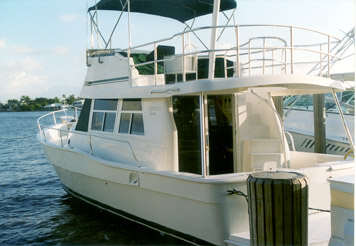
Models reviewed were 1997, 1998 & 1999.
We've often wondered why U.S. boat builders have left the trawler style boat market to the Taiwanese. Even the ones that come with US designer names are still built in the orient. So it was a bit of a surprise when this Mainship popped up a few years ago. Apparently it has caught on well since we've surveyed three of them in the last year.
With a base sampling of three of this model, including a brand new one contrasted with one that's four years old, it's more than fair to say that Mainship should be able to give the importers a serious challenge with this one. We are left to wonder why more builders don't challenge this market niche. As a low cost, price buster type vessel, it offers good value for what you get. While it has the inevitable shortcomings, most of the trade-offs made to keep the price down are fairly intelligent and reasonable.
Most of the quality trade-offs that we observed were not in the realm of seriously detrimental. For example, the painted aluminum window frames appear to have been properly finished. After four years, there was no corrosion appearing. On the other hand, the sliding door had steel rollers on it that went kaput. Further keeping the cost down are all aluminum hand railings and an absolute minimum of hardware. That's fine with me. I'd rather have no hardware than a bunch of plastic junk that will have to be replaced in a few years. Give me a finger hole in a cabinet door rather than a plastic latch. Having nothing is better than having garbage. That seems to be the idea here, and it should come strongly recommended.
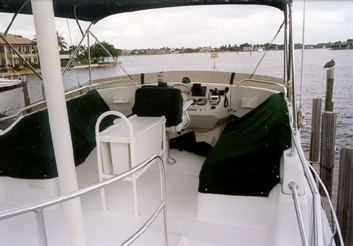
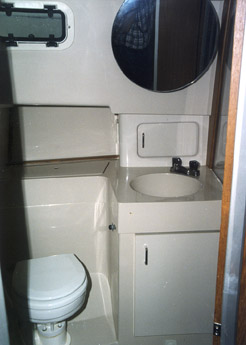
Layout Besides being an economical single engine trawler, that's what sells this boat. Very large bridge with extended deck, large cockpit, fair sized salon, but slightly cramped forward quarters. A good trade off here is a small stateroom for a larger head area, and that's what you got here. It is eminently useable without mashing your head or skinning elbows. All fiberglass liner makes for easy cleaning and upkeep. The master stateroom is a nicely decorated place to flop for the night, attached to a cave style guest that is more or less a nighttime stowage compartment for the kids. It extends back up under the galley with plenty of bed space but little head room.
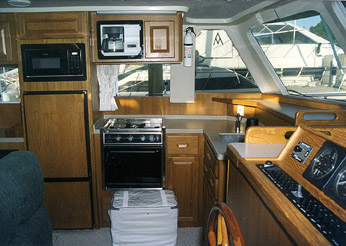
The salon has some teak veneered cabinets built mainly within a fiberglass liner including the overhead. The wood work is reasonably well done, and has more than one coat of varnish on it. The lower helm is nice to have but quite cramped and a whole lot better than nothing when it's nasty outside. With a Princess III gas range for serious cooking beyond sandwich making, counter space is a bit cramped, but you do get a good size sink that one could actually wash something in. The only problem was that there are fabric curtains hanging directly over the stove top. Oops!
Lots of windows make it airy and bright with overall excellent visibility for piloting from below. The extended hardtop and large aft deck sacrifices salon space making her a more outdoorsy type, particularly in conjunction with the large platform extension and transom door. And with the very large bridge deck, this makes for a good party boat, too. With six people on board and a good traffic pattern, there was no cramping or problems of someone always blocking a narrow passageway. There aren't any narrow spaces.
The fiberglass molding work is good and bad. In some places it's very nice, in others less good. The forward cabin trunk is noticeably lumpy and there were obvious flaws in the deck non-skid surfaces. It was also apparent that quite a bit of gel coat break outs during demolding had occurred, resulting in quite a bit of patchwork that was starting to show. Gel coat damage fixes always age to show a different color and become obvious over time. That's happening here, although not glaringly so. Also, the bottom of the 1997 model was beginning to develop blisters.
Mechanical & Electrical The systems are minimalist. There's little plumbing and fewer through hulls. What you get is pretty good stuff and the installations are relatively neat with few screwups. It was nice to note that the DC system came with two 8D batteries and none of this car battery stuff.
The electric panel is located all the way up to the overhead, which is very nice. The only problem is that it has no cover and the breakers can easily be inadvertently switched by someone loosing their balance. It's a dual 30 amp system with a dedicated air conditioning circuit. The 8 kw Onan generator handled the load adequately, but this one is one of those 3600 RPM engines like the Mouse That Roared. You gotta be half deaf to be able to live with noise one of these things make. One of our clients could not and he rejected the boat because of it.
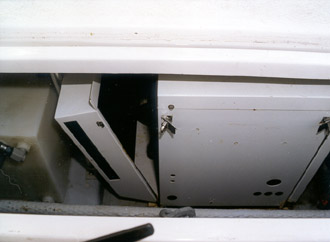
This is as far as the generator sound box cover will open.
Of course, with a single engine, engine access is no problem. What is a problem though is the generator stuffed under the cockpit deck in such way that it's hard to deal with. In addition, it has a steel sound box that was already suffering from an aft bilge section that did not have proper drainage. The generator is mounted so low that the base is getting wet and rusting badly. Of the three boats we looked at, this was the only one with this poor arrangement. The others were different, so this may have since been changed.
Another problem is that the engine and generator exhaust, plus a number of through hull fittings under the starboard side of the cockpit is completely unreachable. There is absolutely no way to get at these things because extra large plastic water tanks are installed. Basically, the cockpit deck hatch arrangement is badly laid out and would benefit from redesign.
The Caterpillar 3116 engines continue to develop problems and this one was no exception. Two of the last three we looked at had problems of exhaust in the cooling system. Word has it that the 31 series Cats have cylinder head design problems and that Cat has declined to do a general recall. They don't offer to fix it until it breaks, which leads you to wonder what they say if the warranty runs out before it does. The Cummins 6BTA engines are a better power choice.
We don't know if they're standard, but all three boats had windlasses using rope anchor rodes when only a chain rode will work with the type of windlass and the design of the above deck chain locker. Rope will not feed through a chain gypsy, and there is no provision for feeding a rope into the chain locker.
Performance Typical of these semi-displacement style hulls, performance above its ten knot cruising speed is just plain goofy. In all likelihood, the swim platform extension, which is really a hull extension, causes the hull to squat and throw a huge stern wave. The bottom of the platform profile does not follow the hull contour, but angles upward from the point of attachment. We don't know what the designers were thinking here, but perhaps they weren't. In any case, the boat will do up to 14 knots (totally empty), but basically one should conclude that it is not intended to go that fast. It would be very uneconomical and very hard on the engine, so figure this as a 10-11 knot boat. Of course, that's what you'd expect it to be any way, so the platform thing is irrelevant unless you are a speed demon who mistakenly bought a trawler.
Sea Keeping We had nice four foot seas in a good tide rip. Overall handling is ho-hum on all points but following seas where you really get stuffed. It wallows and is very hard to control. Typical of keel boats, it tracks a little too well, so that pulling it off the course it wants to take requires a lot of effort. A single rudder on the smallish side is no help. It does not have the large trawler type rudder stepped on a keel skeg like it should for a single screw boat. On the other hand, heading up wind it was quite dry, as you would expect it to be with all that bow flare. No doubt about it, this is basically a fair weather sailor for which you'll have to pick and choose your voyaging days.
Overall, we consider the 350 Trawler superior to most Taiwan offerings in a variety of ways. This one achieves lightness without major sacrifice in overall strength, low cost without giving the appearance or feel of a floating camper. The overall design and use of materials seems quite sensible to me. I liked the fiberglass interior liners garnished with a moderate amount of teak, mainly in the right places. You find sensible type stuff like Corian style plastic counter tops up under the opening forward windshield, as well as just the galley. Nice hand holds here and there, along with other sensible touches. It can be expected to hold up fairly well (Cat 3116's excluded) as the clock keeps on ticking, and certainly won't take a shop vacuum to your bank account year after year.
Posted October 27, 1999





 Visit davidpascoe.com for his power boat books


David Pascoe is a second generation marine surveyor in his family who began his surveying career at age 16 as an apprentice in 1965 as the era of wooden boats was drawing to a close.
Certified by the National Association of Marine Surveyors in 1972, he has conducted over 5,000 pre purchase surveys in addition to having conducted hundreds of boating accident investigations, including fires, sinkings, hull failures and machinery failure analysis.
Over forty years of knowledge and experience are brought to bear in following books. David Pascoe is the author of:
In addition to readers in the United States, boaters and boat industry professionals worldwide from nearly 80 countries have purchased David Pascoe's books, since introduction of his first book in 2001.
In 2012, David Pascoe has retired from marine surveying business at age 65.
On November 23rd, 2018, David Pascoe has passed away at age 71.
Biography - Long version