




Luhrs 340 F.B. Sedan
by David Pascoe
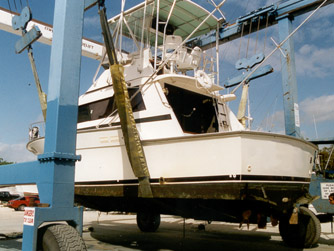
In the past we have avoided reviewing older Luhrs because such reviews would generally bring us nothing but grief. These boats are well known for having problems. Here's one that deserves mention. This is a popular boat and there are a lot of them out there. But there's no mistaking the reason why. Price, price, price.
This little beauty popped out of the mold with a MSRP of $87,295 back in '88 with twin Crusader 350's. By way of comparison, the similarly sized 33 Bertram was priced at $133,685, close to double. Now, if you've ever seen a 33 Berty, then you know that there's nothing fancy about it. Designed for the guys to go fishing in, that's it. We'll leave it to you to decide if what you get for that cost savings of 50 G's balances out to good value.
[We don't mean to be favoring Bertram; it just so happens that they set the standard in this size boat. There are a lot of them, so that's what we use by way of comparison.]
We'll start with an interior that is almost entirely vinyl and foam over plywood panels. We'll spare you any editorializing about that, but after 11 years of use it doesn't look so good. To say the least. If you think the formica interiors of older Bertrams are kinda tacky . . . or perhaps just spartan, this is a real show stopper. The stuff is everywhere. Yet this would be the least of anyone's concerns.
The real concerns begin with the hull where a number of areas of severe stress cracking were found. The worst of these were around the hull side exhaust ports, the stainless steel bezels bolted to the hull sides. Here, a large area around each side was riddled with stress cracks that were more than just gel coat cracks. These were wide and deep, indicating a condition of seriously weakened laminate. Why this occurred was a bit perplexing at first, but then we went and looked from the inside. All this cracking occurred because the hull sides were very thin with no frames or other support. While underway, the sides were panting. Then it was noted that that these ports were very close to the aft engine room bulkhead, and that the cracks were mostly vertical in orientation. But the bulkhead should have been adding strength here, and yet this is where the cracking was occurring. Our conclusion: a very thin hull with too few frames and bulkheads. Plus there was a problem with this bulkhead installation. The same old story with price boats.
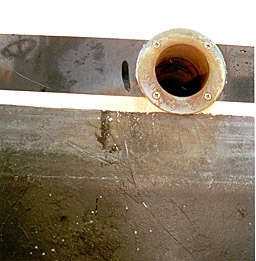
When stress cracks get this big, it's time to start worrying.
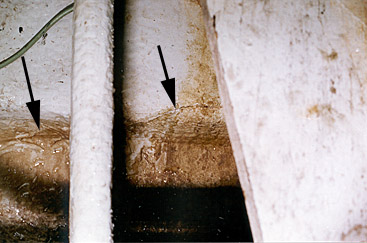
Cracks in hull in way of rudder. Notice the amount of water leakage from the rudder.
This was not the only place that serious cracking was observed. Numerous cracks were found up in the bow area around the chines, deep, prominent cracks. Then there were some lighter cracks on the bottom forefoot that indicated panel deflection was occurring. Yet the worst of it was back aft where wood doubler blocks laminated into the hull for the rudders were found to be completely broken loose, revealing very large fractures inside. The fractures were as much as 1/4" wide. For the most part, it looked like water absorption by the wood simply broke the laminate apart. [Remember how the ancients quarried rock? They drilled holes in the rock, inserted wood pegs and then saturated the pegs with the water. The expanding wood was capable of splitting rock. That's what happened here. How's this for modern engineering?]
The hull and deck have a horizontal lap joint, over which a U-shaped plastic rub rail is installed. The deck is then screwed together through the plastic rail from the bottom up. Obviously, the idea here was to make the boat quicker and cheaper to produce. The end result for the boat owner is rub rails that look like a roller coaster, that end up falling off and a deck joint that leaks like a sieve because the rub rail traps water.
Moving on to the superstructure, the bow pulpit is also cored with wood and it was suffering the same fate as the hull reinforcements for the rudders. Cracks all over and some soft spots. The stress cracks around most of the bow rail stanchion bases was traced there being no doublers on the underside. Along with the cleats, that were just simply bolted straight to the deck. Lean on them and they pry the laminate apart. Can you imagine, there weren't even any washers under the nuts for the mooring cleats? How cheap or lazy can you get? It's a wonder the cleats hadn't pulled out. But perhaps the boat had never experienced a serious storm.
Hearing the bridge deck squeak when it was walked on altered us to another problem. Actually, the deck didn't squeak; it was the aluminum pipe frame for the electronics console, bolted to the top of the helm that squeaked. When you walked on the bridge deck, the deck sagged or deflected so much that the whole helm console moved, and the overhead electronics cabinet with it.
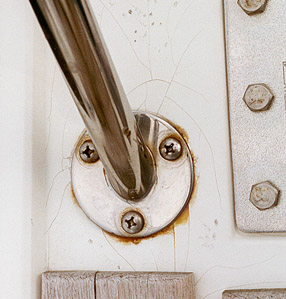
Stress cracking around a stanchion base this severe is more than just a little stress. In this case, there is no backing plate on the underside and the core is rotted. The area under the base is constantly wet so crevice corrosion causes the rust stains.
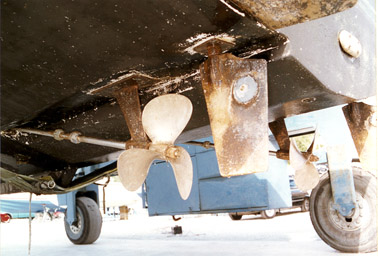
Notice the size of the props in comparison to the struts and shaft. Would anyone believe that skinny strut would hold that big prop steady? Perhaps that's why there's all that nice, fresh, white caulking around the base. Nor is it hard to divine why the rudder doubler cracked. The notch in the hull creates a nice hinge point. Good size rudders though. Steers good.
Looking further, the cored deck was found to have deteriorated. We could also mention the cheap vinyl over plywood bridge side panels that had rotted away. These had been removed and discarded, leaving the raw fiberglass of the inside bridge coaming exposed. The plywood cabinet up under the front of the bridge was suffering a similar fate, and are soon to join the side panels at the local land fill.
We can also add to this mix of loveliness the fact that there is a large footwell molding, screwed onto the forward face of the helm console. All the twisting and flexing that was going on here resulted in this panel breaking loose from its fasteners. Once the screw holes in fiberglass become enlarged, it can never again be refastened without making a mess of things.
The single 295 gallon aluminum fuel tank is mounted under the cockpit deck in a saddle formed by the hull stringers. What we saw here was that apparently the hull stringers deflect so much that the movement and friction was sawing away at the edges of the fuel tank. On one corner it looked as though the abrasion was about wear right through the corner of the tank. About 1/4" of metal on the welded corner was worn away. Yike, nothing like a couple hundred gallons of gas in the bilge to make your day. Combined with the fractures occurring around the rudders, we really had to question the structural integrity of the hull in this area. But lacking sufficient access to the area (most of it being taken up by the fuel tank), we were unable to assess exactly what the problem(s) were.
Since the hull stringers are obviously deflecting a lot, we took this to explain why the stuffing boxes leaked like a banshee, the cutlass bearings were badly worn, and the engine mounts were shot. The drive system was doing a hula dance.
The aft engine room bulkhead was rotting on one side. The source of the leak that caused this was not discovered.
The engine room hull vents angle forward, bringing in salt spray. The engines were a rusty mess. So bad that we suspected that the boat had sunk, but we later proved that it hadn't.
The main engines are not equipped with sea strainers.
The sliding aluminum cabin door has steel rollers and other hardware, all of which rusted away and was defunct.
Particularly amusing was the ACR remote control search light electronic control pad. You know, one of those kind with rubbery little push buttons. The Florida sun had turned all of these buttons to sticky mush. Concentrated, medicated goo. Another well-engineered, quality product designed to self distract before your very eyes.
Okay, so now you know why we've tried to avoid reviewing Luhrs and other boats like these. It's hard to find anything good to say about them. What we have here is mobile home economy applied to boat building. We don't mean to demean people who live in trailer parks. But we're talking yachts here.
It's up to you to decide whether the low price is worth the sacrifice of quality. What we see here is $100,000 worth of boat (with add-ons) that, after 11 years, is basically headed for the grinder. When the client asked us what the boat was worth, we replied that it wasn't worth anything. The cost to fix all these problems was more than the original cost of the boat. Anyone who buys a boat like this will spend most of their money plugging holes in the dike, trying hold back the avalanche of costly repairs they will be faced with.
Further, it was clear that the prior owners had had to plow a lot of money into this boat to keep it going. After only 11 years, it was painfully obvious that there had been an extraordinary number of repairs and replacements. Like engines having been rebuilt more than once because of all the salt spray going into the engine room. There was very little (if anything) electrical on this boat that had not been replaced at least once. The electric panel had been taken apart so many times that the screws would no longer hold all the parts together, even after many more screws had been added.
This boat also paints a clear picture of why older boats of this calibre always have so many jury-rig, substandard repairs and replacements. So much goes wrong so fast that owners can't afford to repair things properly. They couldn't afford a decent quality boat in the first place, so how could they afford one that costs even more to maintain. They thought they could get away with buying a price boat, only to find that they couldn't. Things went to hell so fast they couldn't begin to keep up with it all. The small leak soon becomes a flood that overwhelms the owner, forcing him to sell. The boat is then picked up by someone even less able to afford it than the first owner. After all, the first owner could at least pay the new boat price, but the second and third owners are not even at the borderline edge of affordability. They're buying a broken and clapped out price boat. The little snowball that started at the top of the hill soon becomes a behemoth gathering speed and momentum.
Someone recently wrote us saying that we surveyors were a bunch of elitists with all our talk about Bertrams, Tiaras and the like, and that we didn't appreciate the plight of the little guy. "You talk about quality, but most people can't afford it," he said. Precisely our point, but he seems to have missed it. We know perfectly well that mere size and price is what sells these boats. We present you with these reviews so you can make your own decisions as to whether it's really worth just buying big versus buy good, but smaller.
Moreover, there isn't a mistake that anyone else has made that we haven't made ourselves with our own boats. We have plenty of first hand experience with getting in over our heads with bargain boats. We have learned that they are no bargains. There is no pleasure in boating when your boat is killing you financially. Owning a maintenance hog takes all the fun out of it. It's not exactly a confidence builder heading out the inlet when you KNOW your boat isn't right.
Figure in not only the cost, but the amount of time you're going to spend dealing with it and worrying about it.
If there is any good news to come out of this story, it's that the Luhrs company has mended its ways and in recent years is turning out a better quality product. As you would expect, that comes with a higher price tag.
Posted February 26, 1999




 Visit davidpascoe.com for his power boat books



David Pascoe is a second generation marine surveyor in his family who began his surveying career at age 16 as an apprentice in 1965 as the era of wooden boats was drawing to a close.
Certified by the National Association of Marine Surveyors in 1972, he has conducted over 5,000 pre purchase surveys in addition to having conducted hundreds of boating accident investigations, including fires, sinkings, hull failures and machinery failure analysis.
Over forty years of knowledge and experience are brought to bear in following books. David Pascoe is the author of:
In addition to readers in the United States, boaters and boat industry professionals worldwide from nearly 80 countries have purchased David Pascoe's books, since introduction of his first book in 2001.
In 2012, David Pascoe has retired from marine surveying business at age 65.
On November 23rd, 2018, David Pascoe has passed away at age 71.
Biography - Long version