



Blackfin 29 SF
by David Pascoe
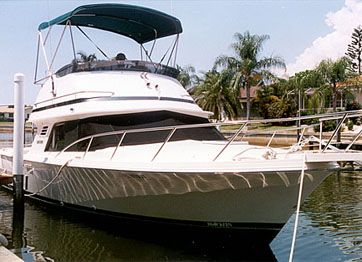
For pure sweetness of design, sea keeping and rough water performance, few boats of its class come close to the Blackfin 29 SF, and it's look-alike cousin the Blackfin 32. At first glance, the two are nearly identical. It has that rare quality seldom found in boat design these days: all the lines are harmonious and blend together into a truly fine looking craft, timeless styling that's neither particularly modern or dated, though the design goes back quite a few years. Yet the Blackfin has yet another rare quality. Its virtues go beyond mere good looks, it's an excellent performer, too.
But like all truly good performers, boats that are designed, not to try to please everyone, but to serve a particular purpose very well, certain trade-offs have to be made. The obvious one is interior accommodations, but more about that in a moment.
One of the very first things you notice about her is how low to the water she is, along with a pronounced reverse curve in the sweep of the sheer that rises slightly in the stern. The first impression is that this must be a really wet boat, but she's not. The bow section is moderately full with a great deal of bow flare that gives it plenty of buoyancy above the waterline, while carrying an extreme angle of hull vee below. She dips into a wave, but rises quickly. Back at the transom, it has an astonishing 28 degree deadrise. One look and you'd think, "Wow, this boat is really going to dig a hole in the water." Wrong. Powered with a pair of 350 Crusader 454's, she's very quick to get up on plane as a result of a very good balancing act performed by her designers. She comes up smooth and level, without pointing her bow toward the sun.
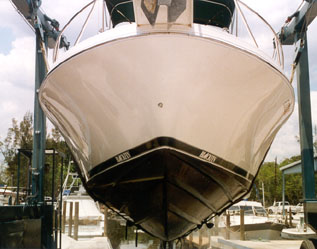
The shape tells the performance story.
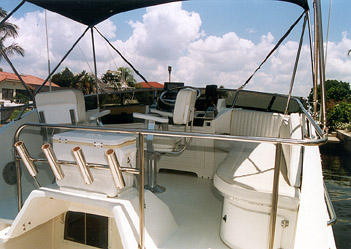
Big bridge for a little boat.
This boat is also available with Volvo or Cummins diesels, although not with horse power ratings that will give you an adrenaline rush; try 230 and 300 respectively. With the Volvos, it's a dog; the Cummins, so-so. Personally, I'd bite the bullet on gas guzzling and stay with the Crusaders. The extra speed in a boat this size is nice to have, and it doesn't overtax these engines. Plus you'll pay with the skin of your nose for diesel repairs, whereas gas engines are cheap.
When you look at the placement of her engines, you begin to understand why. They are in the middle of the hull, with the fuel tanks close behind. All the other significant weights are forward too, including the bridge itself. I'll cut to the chase quick here. With these engines we got a top speed of 29.6 knots at 4000 RPM. She'd cruise along very comfortably at 22 knots at 3000 RPM. But I was really surprised that my testing showed she was up on plane at a mere 2000 RPM. For a boat with an extremely deep vee, that's really amazing. Of course, with 700 hp in a 29 footer, you should expect that. On the other hand, this is not exactly a light boat, said to weigh in at 11,000 lbs dry. While the boat was light, around 66% fuel and no extra equipment, the bottom was not all that smooth and there were still barnacle heads on the props left after scraping. The engines also had quite low compression. With a good smooth bottom and clean props, she might do even better. See update below.
Slow speed handling is equally good. With the engines and props set far outboard, this boat will turn on its axis with absolute ease. You simply will not find a boat that handles better than this one. With one engine in forward, the other reverse, you make this boat foxtrot or tango, take your pick. You could dance this thing around a marlin or sailfish like Muhammad Ali doing rope-a-dope. It's really a wonderful experience finding that she does just exactly what you want her to do.
The ride is exactly what you'd expect it to be: very smooth in a chop, and very sea kindly in the big rollers. However, and this is a big however, her low profile with a very low center of gravity, and big block V-8's down low, the motion of this boat at rest in a sea is really something else. She's balanced in the center and rolls about her central axis. That can make her a bit less steady at the far end of the cockpit, but up on the bridge -- well, there just ain't none of that whip-snap rolling action a-tall. Very, very nice.
While we'd love to rave about how wonderful everything is, the fact is that they do have their flaws. The worst of these is that in some years they used plywood core in the gunwales around the cockpit and these tend to delaminate. Tapping around, we found a lot of hollow areas that indicated that the sandwich construction is not holding together. The hull has the virtue of solid fiberglass, as do the hull sides which are fairly thick -- at least thick enough that they don't shudder when you bang on them. It also has curved plexiglas window sections outboard of the windshield that are notorious leakers, yet it is those curved sections that help make the design so appealing, so you suffer the consequences. And while it's got those nice, hard plastic rub rails, the stainless edge banding is the hollow type that bends and dents so easily. Nor is the deck bonded to the hull -- or bolted like a Bertram -- it is merely screwed together.
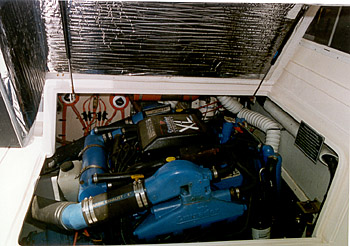
A lot of people look at those huge engine boxes in the cockpit and say, "I don't like that." But I got to tell you that they are not the huge obstructions that they appear to be and, in fact, serve a number of useful purposes. First, they provide excellent access to the engines. General servicing is easy. Secondly, with that very large cabin top overhang, you can sit with your back up against the bulkhead, completely out of the sun, rain or salt spray.
The cockpit, of course, is very low and hits me barely above the knee. For fishing, personally I'd prefer a bit higher gunwale, but I have been scuba diving and spear fishing off one these and I can tell you it's a great boat for any kind of water sport with a walk-through transom door. The down side of this is that there is very little storage space under deck and, in fact very little storage anywhere. That is one aspect that is likely to cause you a bit of consternation. This boat is not very conducive to dragging a lot of equipment along.
The flying bridge is another of her outstanding features. You'll be hard pressed to find another 29 footer that is anywhere near as good looking as this, and yet still has a bridge that can seat four with ease. For our trial run, we had four people up there with no problem at all. Among my pet peeves for bad design are those bridge layouts where no one can get by the helm seats without making some one get up and move. Like a movie theater. The B-29 has this design feature that is very rare among boats even up to 40 feet , a bridge where people can move around without falling over everyone. That's because they didn't try to make it seat more than it was practically capable of seating, which is five.
I was about to say there was no wood on this boat, but there is. The two bridge cabinet doors are wood, and the aft cabin bulkhead is mica on plywood, just like the Bertrams. Well, what do you expect when the last owner of Blackfin, Carl Herndon, came from Bertram? Not really a problem though. It's put together right.
The hardware is all top quality stuff, stainless steel and no plastic or aluminum.
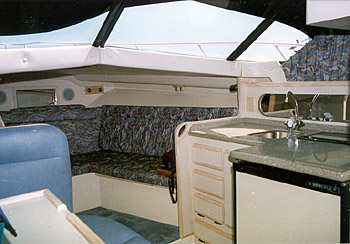
The cabin has a fairly large inner liner that includes the dinette module, cabin sole, head compartment and vee berth area. We found the cabin sole to be a bit flimsy, though everything else appeared solid. As some of you may know, I used to be Quality Control Manager at Blackfin aeons ago, and since they've been building this boat for a very long time, I was looking for what changes they had made and wasn't finding many. They did change the galley a bit over the 1980's models, putting a big notch in it to give a bit more foot space. Then they turned the vee berth area into a settee. I thought both of these changes are an improvement that are both practical, and make what I used to think a very small cabin seem quite a bit bigger. It's an interior of the sort that can take a beating, but still be refurbished easily without it costing you a fortune.
Needless to say, this is not a family cruiser, though it's far from a camper. Two people could be quite comfortable on it for overnighters. Bring the kids and your in for a rough time of it. Only the head compartment is a bit cramped and you'd have a hellofa time trying to take a shower in there. You'd definitely would have to wash your feet elsewhere because there's no way you're going to bend over and touch them. The largish windows make the B29 very bright inside. The aft bulkhead windows not only improve visibility, but aid cross ventilation.
Another down side is that if you want a boat with a generator in it, you can forget about the Blackfin 29. There is no place to put one. It will accommodate air conditioning running on shore power, but no genny.
Another thing I, and many other folks, like about it is the lack of nonsense. There isn't anything on this boat that doesn't need to be there. No geegaws, gimcracks or ooh-aahs. Nothing to impress you. Nothing to impress your friends. Just a good boat designed the way a good boat should be for people who are going to go out in the ocean with salt spray flying all over the place. No simulated wood grain, no molded plastic, and mercifully no dang vinyl (except for a belly rail). The whole thing is designed to be hosed down when you return to the dock.
There's a lot of guys out there who dream of owning a boat like this, and for good reason. It's not hyperbole to call it a dreamboat. She really is.
Oh, and by the way, if you're going to buy one? Don't even bother showing it to your wife. I can assure that she won't like it. One possible exception might be if she has ever gutted a fish. That kind of woman probably would.
Prices start at outrageous and get worse from there.
We're not going to give this one a full five stars since there's limited production stuff out there that tops the Blackfin 29 by quite a bit. She gets her extra half-star from performance.
Update
The B-29 is now available with Cummins 6BTA diesels at 315 hp. These are a pretty tight fit in the engine compartments, although not too bad. We recently sea trialed one with a somewhat dirty bottom and here are the results:
1800 RPM 13.5
2100 18.0
2200 22.2
2400 24.6
2800 29.2 (should do 31 with clean bottom)
Cruise speed trim out angle is 7 degrees. With diesels it swings a 2" larger diameter propeller, which accounts for similar speeds with less horsepower. This is our old friend Mr. Torque. See the Blackfin 32 review for comparisons between these two boats.
Starting in 1996, possibly a bit earlier, some significant changes were made in the deck molds. The flybridge seating was changed from the arrangement shown above to a bench seat in front of the helm. Unfortunately, this cramps up the helm seat quite a bit. It looks fancier, and helm design is really nice. But for the trade, you get a notably more cramped bridge. We like the old style better. The cockpit deck has a greater crown in it, and after over a decade of poorly fitting cockpit hatches, this has been fixed. The transom gunwale now has a built-in bait well. And the gunwale, (deck around the cockpit) has been narrowed by a good six inches, rendering an extra foot in cockpit width. The poor hinging arrangement for the engine boxes has been fixed. So has the troublesome leaky curved section of the house windshield. Notably missing however, were several thousand dollars worth of internal sea strainers. All strainers were external type and were having problems. The head unit has been replaced by that plastic piece of junk by Raritan that grinds itself to pieces in short order.
See also Blackfin 32.


Posted May 27, 1999. Updated June 27, 1999





 Visit davidpascoe.com for his power boat books



David Pascoe is a second generation marine surveyor in his family who began his surveying career at age 16 as an apprentice in 1965 as the era of wooden boats was drawing to a close.
Certified by the National Association of Marine Surveyors in 1972, he has conducted over 5,000 pre purchase surveys in addition to having conducted hundreds of boating accident investigations, including fires, sinkings, hull failures and machinery failure analysis.
Over forty years of knowledge and experience are brought to bear in following books. David Pascoe is the author of:
In addition to readers in the United States, boaters and boat industry professionals worldwide from nearly 80 countries have purchased David Pascoe's books, since introduction of his first book in 2001.
In 2012, David Pascoe has retired from marine surveying business at age 65.
On November 23rd, 2018, David Pascoe has passed away at age 71.
Biography - Long version