




ALL ABOUT BILGE PUMPS
Those Essential Devices for Keeping Your Boat Off the Bottom
by David Pascoe
Oh, what a boring subject, right? Yeah, I agree, reading about bilge pumps is not too thrilling. But this is a subject which I've been harping on for a long time, apparently without a lot of success based on the continuing and overwhelmingly casual attitude that boat owners have for their bilge pumping systems.
- Background
- What Makes for an Adequate Systems?
- Evaluate the Number of Compartments
- Determining the Number of Pumps
- Outboard and Stern Drives
- Capacity of Pumps
- What Brand?
- Pump Installation
- Float Switches
- Open Versus Convered Switches
- Doing It the Right Way
- Discharge Outlet
- Emergency Pumps - Who Should Have Them and Why
- Battery Power
- Wiring Pumps
- Table -
Boat Length/No. of Pumps/Total Capacity-GPH
- Illustration -
Pump Installation
- 2 Photos
Background
Just to give you a little background, I come from a family where marine surveying is something of the family tradition. Years ago, a large part of our family business was handling marine insurance claims.
The hundreds of boats that sunk every year helped contribute to a very brisk business. Having spent many years investigating why they sank, I think I have a pretty good idea why. It's the casual attitude of both boat builders and boat owners toward bilge pumps.
Sail boaters are the absolute worst in this regard. For some strange reason, many of them just don't think that bilge pumps are important. Somehow they rationalize the idea that nothing is ever going to cause their hulls to suddenly flood, so a minimal pumping system is all that is really needed. As in just one pump.
I never ceased to be amazed at the number of sailors who argue with me that one pump is enough. After all, the builder built it that way, and they have that nifty manual pump back there in the cockpit and that can really pump a lot of water. More about that later. FYI: Proportionately more sailboats flounder at sea even though powerboats outnumber them 8:1.
Of course, sailors are not alone in this attitude. For every sailor who thinks little about bilge pumps, there are probably three power boaters with the same attitude.
So why the widespread lack of concern? Well, its the same old problem of lack of experience; its not until they have a problem that they become convinced of the seriousness of it.
Its mainly the people who've had their hulls flooded or even sunk that take the matter of bilge pumps seriously. Its called learning the hard way. I can understand that.
As a kid, I owned numerous small boats, and I can't begin to count the number of times they sunk because it rained hard, or the boat was leaky, and I had no bilge pump at all. Or if I did, I wasn't paying attention to whether it worked, the batteries stayed charged or whatever.
Unfortunately, sinking at the dock can be the least of your worries. The situation that can really get your attention is when you are at sea and something really big goes wrong, and now you are faced with the prospect of the boat going out from under you.
Like having an exhaust hose fail and the engine pumps your hull full of water without noticing that until its too late. That one happens a a lot. Or a sea cock or other through hull fitting lets go because of some corrosion activity that went undetected because the sea cocks which are now 12 years old had never been taken apart and inspected. That happens a lot too.
But when it happens at sea, and the boat has an inadequate pumping system, you've got a disaster in the making. And if you've got your family aboard with you, well you may have to live with a guilty conscience for a while.
Let's start with the premise that next to the integrity of the hull, the integrity of the bilge pumping system comes next. Not the sails, the engines, the interior furnishings or the fancy electronic gizmos, just the plain old, lowly bilge pumping system.
Bad things happen, that's why the government mandates that you carry life jackets aboard. But an even better approach is to have a good pumping system so that you have potentially less need for those jackets.
What Makes for an Adequate System?
This is a question I've been struggling with for years. Unfortunately, there are no pat answers because the criteria for an adequate pumping system depends on the style of the boat, not merely its size. Some types of boats are more vulnerable than others, like sport fishermen and open boats.
In any case, for every type there is a basic minimum. The table below lists what I think that minimum is based on boat length.
| Boat Length | No. Pumps | Total Capacity - GPH |
| 16 - 20 | 2 | 2500 |
| 21 - 26 | 2 | 3000 - 3500 |
| 27 - 35 | 3 | 3500 - 4500 |
| 36 - 42 | 3 | 6000 |
| 43 - 49 | 3 - 4 | 8000 |
| 50 - 59 | 4 - 5 | 9000 - 10,000 |
| 60 - 60 | 4 - 5 | 10,000+ |
There are two factors which must be considered, the capacity of pumps and the number of pumps. The number of pumps is important from the stand point that bilge pumps are not reliable because they are electrical devices submerged in water.
Contrary to common belief, the pumps themselves rarely fail; its the electrical system from which they operate that is usually the cause of the failure. Because of this, one way to improve reliability is with redundancy, or increasing the number of pumps to decrease the odds of complete loss of pumping ability.
Added to the equation is the fact that the pumps are only as good as the battery system supplying power to them. There's not much point in having a good pumping system if the battery system is not up to running them for the necessary period of time. We'll get into more about that in the Battery Power section later.
Evaluate the Number of Compartments
While the table above gives us a general idea of how many pumps are needed, it can't take into account how many compartments there are in the hull that need to have pumps.
Every hull is different, so you have to evaluate your boat from the standpoint of the number of compartments that need to be fitted with pumps, as well as the best location to have redundancy.
To evaluate the number of pumps you need, take a look at the hull and determine where the low point in the bilge is. Water will accumulate at the lowest point, but you need to know where that is.
Next, determine the number of water tight compartments or hull dividers such as bulkheads or high floor frames that prevent free flow of water from one section to the next. That means determining whether there are limber holes in those dividers or bulkheads.
As a general rule, every compartment that doesn't allow free flow of water from one to the other needs to have a bilge pump. At some point, water can rise in this compartment until it finds a way to flow through the bulkhead (such as all those holes for wiring and plumbing) or over the frame into the next.
And while this may not sink the boat if this happens, rising water in a compartment can cause a tremendous amount of water damage. This is actually more of a problem in small boats than large ones. That's because small boats often have very shallow bilges where a small amount of water in the bilge can end up flooding the cabin sole and cause damage. Yet this can also be a problem for shallow bilge sailboats.
Especially for planing power boats, keep in mind that bilge water will flow to the stern while underway if there is free communication, or it will be stopped at water tight compartments. That's why you need to evaluate carefully the location pumps need to be installed.
Determining the Number of Pumps
Now that you know the number of compartments that need pumps, we next relate this to where the water goes when the vessel is at rest, and while underway.
For sailboats, that's pretty easy because the fore and aft trim doesn't change much, so the center bilge is usually the target area.
For most powerboats, the water will accumulate in the mid section at rest and aft while underway. Based on that, you will need the redundancy at these two locations. Any other compartments can get by with only one pump, of a size and capacity needed for normal dewatering.
For any twin engine powerboat over 35 feet (generally excluding trawler types), having four pumps is a good idea; you want the back ups at both points where water will accumulate.
For outboard or stern drive boats with the engines aft, the water will always run aft, so the back ups are only needed at this location.
For sailboats with a keel sump, this is the only location where redundancy is needed, except for larger boats with a dedicated engine room that definitely should have dual pumps because of the potential for plumbing system failures, a damaged stuffing box, exhaust system and the like.
Outboards and Stern Drives
These boats require special attention to pumping systems because of the weight of the engines. Any water in the bilge runs aft and it requires very little water to sink them, particularly when they have self bailing cockpits.
A back up pump should be considered a necessity. The pumps should not be located under the engine where you can't see or reach it. If it is, move it forward to where you can reach it.
The problem with most of these boats is that they have no battery charger, so as soon as the batteries depletes, the pumps don't work. That's another reason so many of them sink. The only reasonable option is to install a marine charger and shore power system. Adding larger batteries will help, but somehow you have to keep them charged up.
Capacity of Pumps
I will start here with a word about those little 4" square boxes that companies that make them call bilge pumps. Yep, I'm talking about the Rule 500 and 800 pumps.
Only a fool would believe that one of those things could pump 500 gallons per hour; they can't and they don't, not even in a horizontal direction, yet alone vertically. I am absolutely adamant that those things should never be used as a primary bilge pump.
Not only is the capacity inadequate for just about any boat except a dinghy, all it takes is a bit of string or hair tangled in the impeller to bring it to a halt. They're okay for use for dewatering small areas where water might accumulate -- like outboard of stringers, but never as a primary pump.
Except for those little buggers, there's no doubt in my mind that Rule makes the best pumps so I'm going to use these as examples. The most common sizes are the 1500 and 2000 pumps, with big leaps up to 3700 and 5000.
We've tested many of these pumps and the one thing to be aware of is that they do not pump at those rates. As near as I can tell, those numbers are for pumping water horizontally, but when you have to pump the water up and out (called static head) those numbers will drop dramatically, by 50% or more when you're moving water up 3 to 4 feet.
My concept of the ideal pumping arrangement is to have two pumps at the one or two points where the water accumulates, at rest and underway.
Let's say you have a 40 foot power boat. In that case I would choose the Rule 2000 and 3700, two of each, using the 2000 as the primary pump and the 3700 as the back up.
Why not the other way around? Mainly because the smaller pump has a lower power demand which is more desirable for normal dewatering. No need to be activating the high capacity pump for everyday needs.
The 3700 serves as both a back up AND an emergency pump. The 3700 has a 19 amp draw, which can deplete batteries fast; in an emergency situation, you will run the engine to keep the batteries charged.
For sailboats, you really have to pay attention to how high the water is being pumped. Needless to say, a weak, a low capacity pump is not the way to go.
For a 40 foot sailboat, pumping the water up 3 feet or more, I'd consider two 3700's the best choice. I have seen 2000 pumps four feet down in the keel with only a small stream of water dribbling out the side. Don't forget that resistance in the discharge plumbing also retards the flow.
What Brand?
After several decades of seeing these pumps in service, I have no qualms about recommending Rule pumps; they're the best.
They are, of course, centrifugal impellor pumps that will not pull the last 1-1/2" of water out of the bilge. If you want a dry bilge, the only way to get one is with a diaphragm pump, and your option there are the PAR pumps (Short for Peters And Russell, now ITT Jabsco).
They are less reliable, but they have the advantage of being repairable, whereas Rule pumps are not. I don't recommend PAR pumps as anything but secondary pumps for dewatering as their capacity is very low, 6 gpm or less. These pumps should only be mounted in a dry, dry, dry location.
Neoprene impeller pumps are also available, but I don't recommend them unless you know how to use them. They will burn up if they run dry, so you can't turn it on and walk away from it. If you use either of these types, you MUST install an inline filter to prevent debris damage to the pump.
Pump Installation
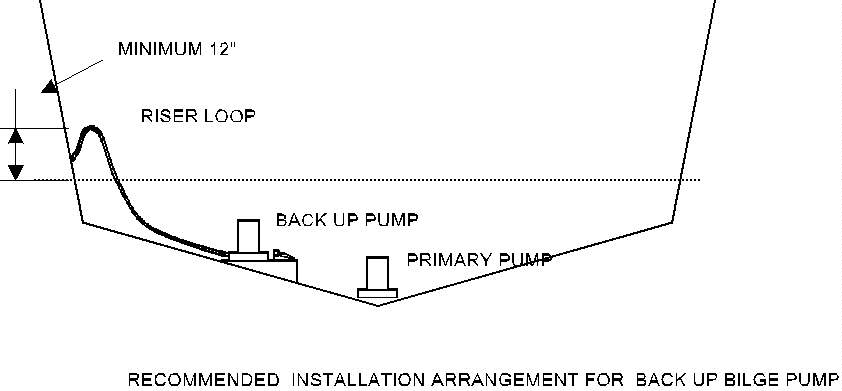
Considering the need for redundancy, there are two ways to install back up pumps. You can install both at the same level in the bilge and locate the float switch for the reserve pump up higher, say 6 - 10" so that it will be activated when the primary pump fails or can't keep up.
The alternative, which I prefer, is to mount the switch and back up pump itself up higher (Illustration below). The reason for this is the tendency of debris in the bilge to foul the impeller over time; mounting it higher up precludes this.
In either case, the installation should be arranged so that the back up pump takes over at a predetermined water height. Preferably this should be at a level before water rises above the cabin sole (or any equipment in the bilge like batteries) and causes damage.
Float Switches
Float Switches
Those wonderful little buggers. Doncha love 'em? Yes they suffer a high rate of failure and you're always wondering why someone can't invent a better one.
Well, devising a better switch would be easy. Problem is, you wouldn't pay the cost of the thing, so we have to suffer with what we got.
Actually, most switches fail not because of lousy switch design, but because of thoughtless installation or lack of maintenance. These are not self-cleaning devices.
There are four things you need to consider for reliable switch installation: (1) no debris in bilge, (2) nothing should interfere with the rise and fall of the switch, (3) it must be wired properly, and (4) it must be protected from the surge of water in the bilge.
Open Versus Covered Switches.
The enclosed float switch would seem like the ideal solution to switch fouling problems except for one thing: you can't see or test the switch.
Further, the enclosed switch is just as likely to become clogged with sludge and things like hair in the bilge as the open switch. Only now you can't even see it. The only problem they really solve is water surge damage.
The open switch is the better choice as long as you clean it once in a while, and locate it so that its protected from water surge.
Sludge is formed when oil in bilge water adheres to surfaces and then collects dirt. Eventually it becomes a tar-like substance that will prevent the float switch from moving.
The switch can easily be protected from surge by simply locating it within 3" of a bulkhead with the flapper facing AFT. Always AFT. See my point? If surging water catches the flapper from the front, it tears the flapper off its hinges. Okay, now that problem is solved.
The next one is that you have to keep your bilge clean. Nothing, but nothing is going to survive a bilge with sludge and debris in it.
Finally, all your wires and hoses have to be secured to that they don't move and end up sitting on top of the switch. Don't forget boats bounce around a lot; those things have to be well secured.
It would be my guess that well over 50% of all pump failures are caused by water getting at wire connections and causing corrosion and high resistance.
People just don't realize that corroded connections cause a power loss that can either cause the pump to burn up, or the wire connections to overheat and terminate all power flow.
That's why its imperative that the wire connections be made as high above the bilge as possible, and that they be protected against getting wet from any other source, like water dripping from above.
Doing It the Right Way
I recommend that the connections be made using a covered, plastic junction box, the one hole type (Such as the Carlon boxes you can get for a few bucks at Home Depot), mounted on the nearest available vertical surface.
Obtain a small terminal block, preferably with brass terminals. If you can't find small ones, cut a larger one in half; they're made to be cut.
Attach ring terminals on the wires, wire it to the terminal block, and put the terminal block inside the junction box and install the cover. You can leave the terminal block loose inside the box so you can pull it out to check or repair connections.
Be sure to mount the box with the wire hole at the BOTTOM, not the top! This is a particularly good way to install pumps in open boats and under cockpits where leaking and condensation sweating is a constant problem. Forget about butt connectors, electrical tape and silicone and heat shrink; none of these solves the water problem.
The Discharge Outlet
Its amazing that after all these years, so many boat builders still do not know how to properly install the discharge plumbing. You'd think any fool would realize that you can't just pump it out through a hole in the hull a couple inches above the water line without the water flowing back in. But they don't.
The discharge outlet is usually placed near the water line because the splash from the discharge goes up on the hull side and makes a mess. So the motivation here is no splash. Fine, but you have to do something to prevent water from coming back in.
That something is called a riser loop. The riser loop extends the discharge hose well above the water line to prevent this. Of course, if for any reason that discharge should go below the water line, you are right back to the reverse siphoning problem again.
Unfortunately, there's no good way to deal with this short of raising the discharge higher up. Syphon breaks and check valves are notoriously unreliable because of their tendency to get clogged.
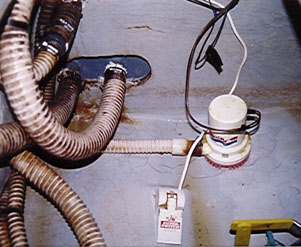
How not to install a bilge pump. You can see by the high water line that it has already failed. The hoses at left were restraining the float switch and the wire connections were laying in the bilge water. They were moved prior to taking this photo. The builder installed it this way.
For power boats, I recommend a riser loop height of about 18" above the water line. For sailboats, you have to consider the heel angle of the hull, which means that it will probably be tapped into the cockpit scuppers or sink drain. Here you have to be real careful of judging the water line right. Sink drains often aren't high enough to tap into it safely, so be sure to check the water level carefully. Its also not a very sanitary thing to do.
Teeing into existing lines is okay as long as you understand what you're doing. The T must always induce water into an overboard on the vertical, never the horizontal plane. This is to obviate any possible backflow. Its best to use a 30 degree angle fitting; a 90 degree T causes turbulence and reduces water flow greatly.
When adding new pumps, you can avoid making new holes in the hull by increasing the diameter of your existing outlet -- say from 3/4' to 1-1/4" and adding a manifold. No, you can't double up on a 3/4" outlet because its too small and will not handle the increased flow and will restrict the pumps. Just buy a larger fitting and increase the existing hole size.
If you find it easier to drill another one, by all means do that. Nor should you ever double up on a plastic t-hull because it will break; if you have plastic, you MUST replace it with bronze. If you do add a manifold, make sure that the lever arm it creates is supported, whether its horizontal or vertical. Also make sure that the hoses are well supported so they don't kink.
Emergency Pumps - Who Should Have Them and Why
"It can't happen to me." That's the attitude. Just as people head out to sea without a life raft, so do they go cruising without a high capacity emergency pump in the event something goes wrong. But it can happen, and it does happen, to all those good folks who thought they'd never need it. Every time you head out, the odds increase that it will happen.
Anyone who does any long range cruising should have an emergency bilge pump. No, I'm not talking about one of those hand pumps. Anyone who's ever tried to work a hand pump for five minutes knows that these things won't do. Even a man in good physical condition can operate one of these things for very long.
A typical disaster that could have been prevented by an emergency pump is the loss of a propeller shaft or a rudder, which opens up a hole just large enough that ordinary bilge pumps can't handle. That's where an engine driven pump can save your boat and your life. If you're going cruising, you should have one. Period.
Yes, they are expensive to install, but they can be MORE valuable than life rafts or life jackets because it may obviate the need to ever use these things.
The idea is to keep you from having to abandon your sinking boat. Engine driven pumps are very high capacity with the volume being controlled by engine speed.
They are more reliable than electric pumps because they're mechanical. The average size pump runs about 50 - 65 gallons per MINUTE, and that's a lot. An honest 3000 GPH, a capacity that can deal with some serious hull flooding.
For smaller sailboats, installing one can be more difficult because there's no space at the front of the engine. The solution is to add a pulley to the propeller shaft and drive it from there.
It has to be operated with the engine in gear, but it will still do the job. You may be able to find a split pulley (in 2 halves) that will make installation a lot easier. Instead of having to remove the coupling, all you have to do is drill a slight detent hole.
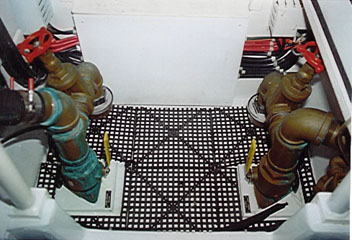
Shown in the photo below is another good option, a suction take off from the main engine pumps. Its a whole lot cheaper, but the only draw back to this arrangement is that if you run the engine pump dry, you burn up the impellor and now you've got another problem.
This arrangement is a lot cheaper than adding a belt driven pump, but if you go this route, make sure that you understand what you have to do to operate it without wrecking the engine. It takes two people. Also make sure the T-off is BEFORE the sea strainer so that you're not sucking up bilge debris into the engine.
Battery Power
Okay, we've covered just about everything with the pumping system except the power source. For larger boats with big batteries, this is rarely a problem. Its a huge problem for small boats where all the builder saw fit to provide were an el cheapo car battery or two.
I don't care that it says MARINE on the side of it, it you're got those brightly colored, thin casing plastic batteries, its not a marine battery. I don't care if it says "deep cycle" or that it can light up the universe, I've yet to see one that isn't a piece of junk.
My auto mechanic tells me the same thing; the average car owner is replacing batteries every two years because they are junk, junk, junk. Just a big sales racket.
If you want to save bucks by using cheap car batteries in your boat, you've wasted your time reading this because your pumping system is no better than the batteries that run it. Batteries die, pumps die.
Here's the deal: as batteries age, the amount of charge they hold begins to drop dramatically. Two 14 amp pumps equals 28 amps, and wired to a common 60 ampere hour battery means that the two pumps would theoretically exhaust a new battery in two hours. But it never works out that way because as the battery declines, its ability to provide power declines at an accelerating rate.
When the battery is older, the problem is even worse. The average one year old 60 AH battery will barely run a 14 amp pump for 30 minutes. And if you have to pump that water uphill, it gets even less than that because the pump is straining at maximum current draw.
Do you get the picture? Take it from someone who has screwed around with cheap batteries most of his life, it is not worth fooling with those things.
Go for a heavy duty commercial or marine battery. Surette, American, Exide, any of the big battery makers. You can tell if its for real if its big, black, very heavy and costs twice as much. Good batteries are heavier because they have more lead, for one thing. You are better off with one size 8D battery than you are with two smaller, cheap ones.
Capacity is DIRECTLY related to size. Paring up two small ones is no match for one large one. An 8D (250 AH) costs about $250.00; two 90 AH auto batteries are going to cost around $100 each, so the cost isn't that much more. A pair of 4D (125AH) will work nearly as well.
Wiring Pumps
The common mistake in wiring pumps is to wire them after the shutoff switch or the main circuit breaker on the panel. It happens often that someone turns off the main power without realizing that he is also shutting of the bilge pumps.
To test whether your boat is wired wrong (and many are) turn all the power off and then test the pump by lifting the float switch. If it doesn't go on, then you know what the problem is.
I do not agree with the ABYC standard that bilge pumps must have circuit protection. Far too often, the circuit breaker or fuse is the cause of a boat sinking. If you want to eliminate circuit protection, try to keep the wire run as short as possible.
While its not good practice to wire anything direct to the battery, I'd say the lone exception would be bilge pumps. If there's no other practical way, go ahead and do it. This applies to submersible pumps only. These pumps have no history of burning up and starting fires.
When adding pumps, the easiest way is to purchase the small Rule three-way switch panel which has an indicator light too. Where to find a power source can be one of the more difficult tasks, especially if you're adding a pump up forward. Don't make the mistake of tapping off some other equipment or bus.
Take the time to string the wire right. Your options are to go to the main panel, direct to the battery, or from the terminals on the back of the battery switch, making sure that you get the one that's always energized. In most cases, going direct to the battery will be easiest.
No doubt someone will send me an e-mail saying "How dare you recommend violating the rules," but I am not telling you that you must go to the main panel because with many panels that is nearly impossible to do.
Related reading at Dockside
Reports:
Bilge
Water Blues - Solving the Problem of Leftover Bilge Water
Marine Investigations: Chapter 5 - Bilge Pumps & Batteries





 Visit davidpascoe.com for his power boat books



David Pascoe is a second generation marine surveyor in his family who began his surveying career at age 16 as an apprentice in 1965 as the era of wooden boats was drawing to a close.
Certified by the National Association of Marine Surveyors in 1972, he has conducted over 5,000 pre purchase surveys in addition to having conducted hundreds of boating accident investigations, including fires, sinkings, hull failures and machinery failure analysis.
Over forty years of knowledge and experience are brought to bear in following books. David Pascoe is the author of:
In addition to readers in the United States, boaters and boat industry professionals worldwide from nearly 80 countries have purchased David Pascoe's books, since introduction of his first book in 2001.
In 2012, David Pascoe has retired from marine surveying business at age 65.
On November 23rd, 2018, David Pascoe has passed away at age 71.
Biography - Long version