




Solving
Chronic Battery Problems
by David Pascoe
The experience of many, if not most, boat owners is that short battery life and dead batteries are a chronic problem. In this essay I will discuss why this is so and what you can do to eliminate this problem. There are three primary reasons why battery problems occur:
- Poor quality of batteries or inadequate battery power
- Faulty installation
- Faulty charging systems
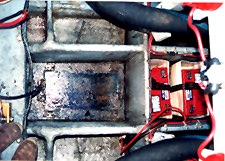
This boat had a problem with chronic battery discharge because the batteries were sitting on the bottom of the hull.
Damages Caused by Faulty DC Systems
Any or a combination of faults in a DC electrical system can cause serious damage to electrical components. Engine starting motors in boats are so infrequently used that they should never have to be replaced. And yet engine starting motor failures are a constant source of trouble. The reason is either poor quality batteries, improperly maintained DC systems or substandard wiring. High resistance in electrical systems, combined with low voltage is deadly to electric motors, especially DC motors which run on only 12 volts. If you're having a problem with electric motor failures of any kind, chances are (unless the damage is caused by water leaks) the problem is related to problems with the system itself.
Quality and Capacity
It is very common for the builders of small to midsize boats to supply both low quality batteries and batteries that are of insufficient capacity to supply the needs of the DC electrical equipment on board. Unlike nickel-cadmium batteries, which need to be completely discharged occasionally, lead-acid batteries become damaged when heavily discharged. Allow a battery system to become partially discharged and it becomes seriously weakened and never again will return to its original, full-charge rate.
For this reason, it is important not to allow battery systems to become depleted. But this is nearly impossible when the total ampere/hour capacity just barely meets the total demand, for the batteries are constantly being over-taxed.
For example, it is very common to find 28 footers with a gang of electrical equipment on board, including an AC/DC refrigerator, that is equipped with only a pair of 60 A.H. car batteries. Even though it probably says something like "auto-marine" on them, automotive batteries are discernible by their thin, cheap plastic casings. Auto electric repair shops tell us that these days that the quality of automotive batteries has declined substantially. One of the primary cut backs in quality is the size and quality of the lead plates that generate the electricity. These thin, low-quality plates not only don't last as long as better quality units, but also very quickly begin to experience a falloff in the total amount of power they can generate. This, in turn, taxes the battery even more, thereby shortening its life span.
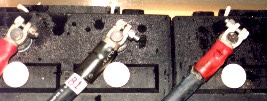
Cable ends swaged to lead battery lugs like these are the proper type of connection.
In other words, what are being passed off as "marine" batteries are really car batteries that not suitable for marine use. True marine batteries are distinguishable by both their heavy plastic casings and their substantially greater weight. They weigh considerably more because the lead plates will be close to twice as thick as automotive batteries. Because plates corrode in the process of generating electricity, plate size and thickness is the criteria for quality. Generally speaking, the thicker the plate, the longer it will last.
Proper Installation
Some boat owners complain that even when they purchase top quality batteries, they still don't seem to last long. This is usually because of faulty installation or poor maintenance. Whether you're using gel cells or standard lead-acid batteries, they still have to be maintained. Here's a short list of common life-shortening factors.
-
Batteries must be kept clean and dry. If the top surface of the battery gets dirty or wet, a small flow of electricity will flow between the terminals as the water creates a conductive path. If installed in a location where water can drip onto them, this can cause the batteries to discharge fairly rapidly.
-
When boats bounce around, the electrolyte fluid in lead-acid batteries will spill out through the tops. This creates an excellent electrical path for stray current and can lead to rapid discharge. Clean battery tops with a damp sponge or rag, then wipe dry with a paper towel. This should be done at least biannually.
-
Batteries must not be sitting on a wet or damp surface. To understand the importance of this, just take a fully charged battery and set it on an apparently dry concrete floor. It will discharge right through the casing in about a week. Even the plastic casing is not a total isolator. Surveyors frequently find batteries sitting directly in the bilge water, or on a deck that gets wet from water leaks above. Or, the batteries are mounted in boxes that, one way or another, collect water.
-
Wire splices. Particularly on smaller boats where much of the wiring will get wet from leaks and spray, if the electrical system has had alterations and additions that utilize butt connectors, these devices, when they get wet, particularly with salt water, are very good at leaking current.
-
Wiring exposed to bilge water. Very often we find battery cables laying directly on the bottom of the hull. So, too, do we find wiring laying on the bottom, often running through pockets of accumulated water such as outboard of the hull stringers. Be assured that these wires are leaking current to some degree.
- Batteries located in inaccessible
location. This is a very common problem. If the owner has
to stand on his head or crawl on his belly to reach the batteries,
they're not likely to get serviced. To make matters worse,
its going to cost a lot more to pay someone to get them in
and out of that tight hole. Most builders will put the batteries
right next to the engines so that they can save the cost of
long cables. Consider relocating your batteries to a more
convenient location if they're in a place where they can't
be reached or get wet. Ultimately, it will save you a lot
more than the cost of moving them.
- Cheap battery boxes. You know, those
red-and-white jobs with that impossible belt buckle that goes
over the top to hold it in place. With our hectic way of life
these days, who's going to wrangle with these little monsters
to service the batteries? Most boat owners don't, and there's
the problem. These things retail for less than $20 and aren't
worth a nickel. Depending on size, good quality battery boxes
cost $50-$100 and they're well worth the cost when you think
about replacing three or four hundred dollars worth of batteries
every two years.
Be sure that the battery box has a hole in the bottom that will let water drain out. Rinse out the bottoms of the boxes occasionally with fresh water to remove spilled acid. What small amount of acid that gets into the bilge will not be harmful.
Battery Chargers
There's no point in having good quality batteries and a low quality charger. Cheap chargers will ultimately do more harm than good and here's the thing to remember.
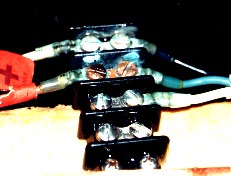
This wet and corroded terminal block was leaking current between positive and grounding wires because the terminal block was damp and salty. Conditions like this are one of the major causes of chronic battery drain.
A brand new, good quality 12 volt battery, depending on size, will generate between 13.0 and 14.5 volts. That's because each cell will generate slightly more than 2 volts per cell when they are new. But as the batteries age, they will progressively generate less voltage and power per cell.
Cheap battery chargers cannot adjust for these changes in total voltage over time. They're factory set to charge the battery to the original power output. A battery that takes a total charge of 13.5 volts this year may only be capable of coming up to 13.0 volts next year. This results in overcharging, a condition which damages the battery and results in a rapid loss of life. Better quality, and therefore more expensive chargers, are equipped with devices to detect when the battery has reached its maximum charge level and then shuts down, thereby saving it from overcharging. NewMar and Professional Mariner are but two manufacturers of good quality chargers. Avoid buying a charger based on price.
Cable Connectors
It is very common for builders of smaller boats to attach battery cables to the terminals with substandard connectors. Foremost among these are ring terminal ends attached with wing nuts to threaded studs. There are a number of things wrong with this arrangement, not the least of which is the tendency of the connections to come loose. Secondly, it's likely to be creating a high resistance connection. The bottom line is that the cables should never be connected in this way. Nor should cable ends use steel end clamps that will rust and create resistance. Cables should be swaged to heavy lead lugs with the standard clamping arrangement to the battery post. If your system does not have swaged lead terminals, get them changed soon because they can be causing damage in more ways than one by creating a high resistance connection.
If you are having a problem with large accumulations of white crud developing on the battery connections, this is because either you're not keeping the battery tops clean, or the batteries are constantly leaking fluid. Another major difference of good marine batteries is that the top of the plates are located well down from the top of the battery. This means that you don't have to fill it to the top with water. If you do, it will leak out. For high speed boats that do a lot of bouncing around, consider changing to gel cells.
Summary
Even if you own a boat with a substandard DC electrical system that has a continual problem with battery discharge, it is neither difficult nor particularly costly to upgrade your system and keep it functioning at maximum performance.
Correcting one or more of the above defects, if you have them, will save hundreds, even thousands of dollars in damage and replacement costs. God quality batteries should have no problem lasting three years or longer. Compare that with the cost of breakdowns and replacing batteries every 18 months or so.





 Visit davidpascoe.com for his power boat books




David Pascoe is a second generation marine surveyor in his family who began his surveying career at age 16 as an apprentice in 1965 as the era of wooden boats was drawing to a close.
Certified by the National Association of Marine Surveyors in 1972, he has conducted over 5,000 pre purchase surveys in addition to having conducted hundreds of boating accident investigations, including fires, sinkings, hull failures and machinery failure analysis.
Over forty years of knowledge and experience are brought to bear in following books. David Pascoe is the author of:
In addition to readers in the United States, boaters and boat industry professionals worldwide from nearly 80 countries have purchased David Pascoe's books, since introduction of his first book in 2001.
In 2012, David Pascoe has retired from marine surveying business at age 65.
On November 23rd, 2018, David Pascoe has passed away at age 71.
Biography - Long version