



Sea Ray 39 Express
by David Pascoe
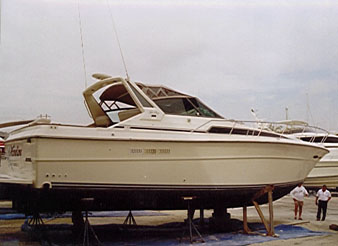
We'll start by saying that we basically like this boat. Its been produced in various incarnations since 1983 and is the big brother to the 36 Express with little difference other than size. But we'll also say that they come with some maddening faults that prevent us from giving it a solid four star rating.
As will all boats that are produced over a long period of time, you expect that most of the bugs will get worked out over the years, yet in reality, this is rarely the case for some builders. A lot of faults that you will find in a 1984 model you won't find in a 1992 model, but there are enough of them remaining to make you wonder why, since they'd be so easy to correct.
The interior layout is great, and we like the fact that it is easy to move around in this boat without always bumping into things. The traffic lane from the cockpit through the cabin is very good for active people who move around a lot, which is one of the great features of the express design. You don't feel worn out after a day of a lot of climbing around. The "great cabin" layout is good for the very sociable types who don't want a lot of privacy. On a rainy day, you can actually spend some time inside without feeling claustrophobic with cabin fever. In the south, this is nice for just getting out of the heat and spending some time in air conditioning.
Four people can actually cruise for a while on this one without being in each other's face all the time, despite the lack of private cabins. Yes, there are two staterooms, but a better descriptive adjective might be "sleeping space." The head compartment is just a tad small, loosing a lot to the shower stall.
The quality on this one, as we complained in our intro, ranges from good to poor, depending on where you're looking. In the later models it got quite a bit better than the 80's models, but there are still a lot of weaknesses. Start with the windshields and cabin windows that leak excessively. On the earlier models, the water leaks in and goes into the sunken area of the instrument panel and thence down into the cabin below, often causing a lot of damage, even to the refrigerator. These leaks are extremely frustrating and apparently impossible to stop, for just about every one we see
On later models, in a driving rain or a lot spray, we usually find a lot of water sloshing around up under the windshield, soaking everything you put up there. The forward opening side vents don't help this any.
Early models have a lot of mica on plywood cockpit panels that rot badly, including wood seating units. On later models much of this was replaced with more durable materials. But to our liking, there's still too much vinyl upholstery and too much plastic. A lot of plush usually translates to a lot of non durable materials.
The engine compartment and what's under the cockpit is a real sore spot. The layout down below is very poor. You'll find generators sitting nearly on the bottom of the hull and all rusted up because they're constantly getting wet. You are forced to stand in the bilge where you can slip in the oily water and hurt yourself. The stuffing boxes have no splash guards and usually throw water all over, damaging nearby electrical apparatus. Since the centerline generator blocks your access to the aft bilge area, you usually have to move a very heavy rear seat to open the hatch where, once again, there's nowhere to stand except in the bilge water.
On some earlier models we've found stringer movement that has disturbed the fuel tank mountings. We've found fractured tank beds and broken hold down straps, although no fractured aluminum tanks yet. This is something that you want to look at closely. These large wing tanks force the location of the exhaust piping into the central spaces where you don't want them and they get in the way of servicing just about everything. And the large, cannister style mufflers don't help. This is a boat that should have fiberglass centerline tanks which would turn the engine room into a do-it-yourselfer's dream. Instead, the inability to reach things means that things don't get serviced, and is one of the reasons we find so many of these boats with very poor maintenance.
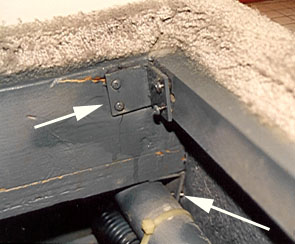
When we find floor frames breaking apart like this, its usually an indication that all is not well. Namely that there is excessive flexing in the hull structure.
A lot of builders just don't give a darn about serviceability, but they should realize that how their boats look 5 or 10 years later deterimines what knowledgable people think about them. Things like this establish reputations, and Sea Ray has never been very good in this regard.
Sea Ray's continued insistence on using plastic through hulls and cleap plastic hoses has sunk a lot of their boats. As the cheap plastic ages, it becomes brittle and fractures. Further, these hoses usually aren't supported, a factor which speeds the breakage process. There is no excuse for this nonsense, yet they continue to do it.
Performance is a mixed bag. With the propeller pockets you get a real shoal draft, but at a big cost in performance. Coming in at around 17,000 lbs. this is a very light boat for its size. Compare this with the Bertram 38 II Special at 29,000 lbs and you see why there should be no performance problems. Yet the propeller pockets stand her up on hind legs while getting up on plane, which takes far too long, while you can't see where you're going just looking at the fore deck. We typically find Cat 375's or Mercruiser 454's in these boats. With the diesels, once she's up and running she's okay, but it definitely needs trim tabs to do it. With the gas engines, we think its underpowered and wouldn't have one.

While the deep propeller pockets gives a very shallow draft, it comes at a steep price in performance.
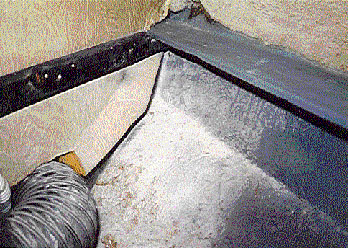
This eary model 39 had an angled bulkhead which broke loose, causing fractures in the hull sides. The white dust is ground fiberglass from extreme working of a bulkhead adrift. Installing a bulkhead on an angle is guaranteed to do this, so where are the engineers?
Slow speed steering is terrible and she wanders around and tracks poorly at idle speeds, causing you to constantly oversteer through all those no wake zones. And while we had no trouble docking, operating boats is something we do every day. But a lot of owners have trouble. Rather amusing to watch at a crowded gas dock on Saturday morning.
This hull shape, as shallow as it is, unquestionably is a fair weather sailor. The depth between water line and keel at the stern is only 18", amazing for a 39 foot boat. Out on the stream with three footers rolling, she comes to a grinding halt unless you want to bash her to pieces. She's okay for big bays and the like, but we wouldn't even consider it for cruising the Bahamas.
Overall, these boats hold up better than we'd expect. But its the kind of faults cited above that keep these boats dogged down in the near entry-level category. Sea Ray ought to get rid of some of the bad hair day types, pick themselves up by the boot straps and give Hatteras and Tiara a run for their money. It would cost them very little to transform this level of quality from something surveyors often snicker about, to something they'd have no trouble recommending to clients. With an additional $2,000 per boat in extra engineering and a little materials, we could easily transform the 39 Express into a rock solid yacht.
Stretching their dollars to get the biggest they can afford, most buyers are forced into this kind of choice. Its not necessarily a bad one, but in our view, not a very good one either. In this used boat category (casual cruising or serious partying), we'd be forced to consider it too. Its a great cocktail circuit cruiser, but if you have to go when the wind blows, better consider something else.
Frankly, we reluctantly give her three stars. So close but so far. Whether the good outweighs the bad ultimately comes down to personal preferences and we'll give it the benefit of the doubt.





 Visit davidpascoe.com for his power boat books



David Pascoe is a second generation marine surveyor in his family who began his surveying career at age 16 as an apprentice in 1965 as the era of wooden boats was drawing to a close.
Certified by the National Association of Marine Surveyors in 1972, he has conducted over 5,000 pre purchase surveys in addition to having conducted hundreds of boating accident investigations, including fires, sinkings, hull failures and machinery failure analysis.
Over forty years of knowledge and experience are brought to bear in following books. David Pascoe is the author of:
In addition to readers in the United States, boaters and boat industry professionals worldwide from nearly 80 countries have purchased David Pascoe's books, since introduction of his first book in 2001.
In 2012, David Pascoe has retired from marine surveying business at age 65.
On November 23rd, 2018, David Pascoe has passed away at age 71.
Biography - Long version