




Moisture Meters on Boat Hulls:
Do They Produce Reliable Results?
by David Pascoe
This article and the two months of research that preceded it were prompted by the numerous phone calls and e-mails that I receive from boat buyers asking this question.
They have had surveys performed on boats they propose to buy on which the surveyor used a moisture meter on the hull. The surveyors gave them the results of the meter readings, but were apparently unwilling or unable to provide a comprehensive explanation of those results; at best, these people told me, the surveyor’s advice was vague. This, of course, left the boat buyer with more questions than were answered.
Use on Composite Cored Boat Hulls
At that time I knew little more than what any other surveyor already knows, mainly that meter readings can be difficult to interpret at best, and unreliable at the worst.
This is not the meter’s fault, rather it is the result of a wide range of unknown factors that can influence the performance of the meter, as well as the manner in which the surveyor uses it.
Of all the meters I have investigated, virtually none of them provide any information for their use on composite boat hulls. This prompted me to do some testing on how meters actually perform with a wide range of materials and circumstances.
Some of the major questions to be answered were:
-
How does the density of the material being tested affect the meter readings?
There are a wide range of differing types and quality of plastic resins being used. Moreover, it is well established that laminate density and quality is highly variable owing to the fact that it is a hand made product.
-
Can a meter be reliably used on a hull that has just been pulled from the water? Will a recent rainstorm affect its readings?
-
Does the type exterior finish such as gel coat, paint or bottom paint affect the results?
-
Can a meter be used to successfully detect water in a core?
-
Does temperature and humidity affect the results?
-
Will a meter read through a laminate to detect water on the inside of a hull,such as water in the bilge, and will these produce false readings?
These are just a few of the questions that can be raised about the use of moisture meters, and which I set about trying to answer.
It must first be pointed out the major difficulty of obtaining the right kind of laminate samples to be tested since I can’t go around cutting up boats to get what was needed. Therefore, the range of proper samples significantly limited what I was trying to accomplish.
The range of samples was limited to what I could scrounge from the dumpsters of boat builders, boat yards and pieces cut from wrecked boats.
While additional work was performed directly on boat hulls, the difficulty with working directly on boats is that the thickness and quality of the laminate remains unknown, whereas with a sample the edges can be examined under magnification to determine its thickness, density as well as porosity and the inevitable voids.
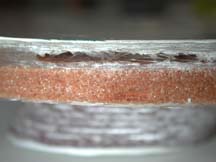
Voids can be large or small, water-filled or not. Taken out of a hull side below waterline, this void was filled with water.
Laminates, whether cored or solid, contain millions of voids, due in part to air entrapment as well as problems with out-gassing during cure, plus just plain sloppy workmanship.
Further, the skin-out layer of chopped strand mat or chopper gun as it is sometimes called, is well known to be extremely porous and will absorb large amounts of water.
This has been directly linked to the cause of blistering. This is by far, the major cause of most water absorption by laminates. Structural laminates, those containing the major structural fibers, are far less prone to absorbing water.
This leaves us the question of what is the location of the water that our meters are reading? Is it in the gel coat, the CSM layer, the structural laminates, the core or all of theses?
Clearly, when working on a boat hull, there is no way of knowing. What with the reintroduction of cored boat bottoms, the most critical question that the surveyor wants to answer is whether water has gotten into the core because this can be fatal to boat hulls.
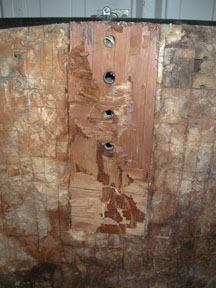
The ultimate horror story for boats: Outer skin of hull is removed to display water-soaked balsa core.
This area is around a chain plate with a plywood doubler (center). Both the plywood and balsa are equally deteriorated by acid corrosion. Even though it is darkened at lower right, the balsa is equally wasted at upper left.
Testing on Recently Hauled Boats
I received a phone call from a fellow who just had a boat surveyed and was handed a report that said, "Entire bottom has elevated moisture readings."
The boat had been hauled only several hours before the readings were taken. Two weeks later I was asked to double check the readings by the owner. The readings I got, inside and out, all were dry.
Random testing of boats just hauled from the water (with bottoms that are dry to appearance) demonstrates conclusively that residual moisture within paint layers, the gel coat or CSM layers will produce erroneous readings most of the time.
This was determined against taking readings randomly on boat bottoms that had been sitting on shore for much longer periods that produced aggregate readings that were much lower than the just hauled group. Even so, the on shore boats still produced large numbers which the meter said were wet.
What was notable about this later group was the fact that the wet readings tended to be lower toward the keel whereas the just hauled group were more uniformly wet all over.
The conclusion here is inescapable: metering boats just hauled from the water is highly unreliable and prone to produce false readings.
Gel Coat Testing
The next question to be answered is one of how gel coats behave. Are gel coats more prone to water absorption? Is there a difference between gel coat below the water line versus above?
Tests were performed under varying climatic conditions. Moisture meters will not read frozen water; place the meter on a piece of ice and the reading is zero.
Humidity levels were proven to have little effect except on wood. The difference in meter readings on a laminate at 40% humidity versus 90% was only 4 points on the meter scale.
The decks of dozens of boats were tested immediately after rainfall. Here, the wet gel coat was dried with a towel and measured immediately. It was very much a surprise that readings were almost always near zero, even on old boats with weathered gel coat.
From this we conclude that gel coat above the water line that is not subjected to water pressure absorbs very little water. Thus, the use of a meter to detect wet cores beneath the outer skin on things like decks and stringers will produce reliable results.
Does salt residue affect meter readings? The answer to that is absolutely yes. If there is salt residue on a dry deck or hull it will affect readings by as much as 50% on an apparently dry surface.
On the other hand, wiping a surface with a clean cloth removes the residue sufficiently that the reading is affected by no more than 10%.
Uneven Surfaces
One might think that capacitance meters would read poorly on rough uneven surfaces like the insides of hulls and non skid decks. In fact, the meter reads remarkable well on moderately rough surfaces. Even so, one should try to obtain the smoothest surface possible.
How Deep Do Meters Read?
This, of course, is a critical question for surveyors which, unfortunately, our testing produced no hard and fast answers.
This is largely due to the fact that the quality and consistency of the material being tested cannot be known; we are testing an essentially unknown material. However, our findings did reveal some important results.
These included the fact that the denser the material, the more capable the meter was at reading through it. The meter would readily read through a half inch of vacuum bagged laminate to water on the other side of that laminate, whereas reading through a hand lay up laminate produced results that were around 25% lower. A meter will not read water through any kind of dry core.
The principle here is that entrapped air space blocks the instrument’s signal in the very same way it does with ultra sound.
The implication of this factor is that false readings can occur if the meter is placed over a void, delamination or resin-starved laminate.
The material behind it can be soaking wet and the meter will not pick it up on that spot. Fortunately, random false readings can be avoided by using the meter in a scanning mode.
That is, don’t take "spot" readings but move the meter around a bit. The meter works very well by dragging it across the surface over a sizeable area. This will defeat random false readings unless there is massive delamination, in which case that is detectable by other means.
Part of the problem in answering this question comes from the fact that we cannot determine whether we are reading moisture behind the laminate versus within the laminate.
This is the fundamental problem with trying to meter hulls for wet cores; the meter won’t tell us what part is wet, the skin, the core or both.
A factor that affects this so greatly is with immersed hull areas, water pressure is exerted against the hull skin, and the deep it is, the more pressure. This probably explains why we find more wet readings in lower hull sections than in higher sections.
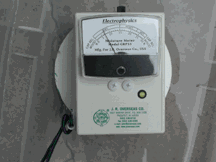
The moisture meter does not read through this 3/4" cored sample from a hull bottom that is sitting in a tray of water.
By Passing the Limitations
Fortunately, there are some techniques by which we can make the meter more useful in our quest to evaluate hull cores.
The first and most important of these is to use the meter on the inside of the hull rather than the outside. The inner skin of the laminate, of course, is not submerged, and therefore should not be wet. Thus any wet reading obtained on the inner skin – after assuring that the surface is clean and dry – will be a positive indicator of a wet core.
This is bolstered by the fact that inner skins are usually about 30% to 50% thinner than outer skins, so there is less opportunity for the skin to affect the reading.
Another, though less reliable, method is to search for areas on the hull bottom that read dry. This idea is based on the premise that if the hull skin is universally absorptive, the bottom should read universally wet.
If there are a number of areas that turn up relatively dry, this becomes a fairly strong indication that certain areas of the core are wet. This should be confirmed by doing at least some limited testing from the interior.
False Positives
False readings can be produced by a number of conditions that include excessive amounts of CSM on the outer surface, the use of absorptive fairing materials, ablative bottom paints and paints containing metals and oxides of metals, with copper topping the list of metals. Be careful and skeptical of readings taken around keels, struts, rudders and other areas that may contain fairing.
Water in the bilge or trapped in hull areas will definitely affect readings taken on solid laminates. On the other hand, water cannot be detected through a dry core of balsa or foam, no matter what its thickness is.
Watch out for things like box stringers that may be full of water, bilge sumps and the like. Before metering the outside of a hull, we should be familiar with what is on the inside and where. Keep in mind that the meter will read right through " of solid glass even though the glass itself is dry.
False Negatives
False dry readings can be obtained after a core has completely rotted or otherwise broken down. At this point there may be no water saturated material that is in contact with the outer or inner skin and the meter reads low when, in fact, the core is wasted away.
This has proved to be a problem with older boats that have very thick skins that don’t deflect much. I’ve had numerous cases where sounding did not reveal a wasted or delaminated core and neither did the meter pick up any wetness.
Old Bertrams and Hatteras are good examples of the kind of boats where this happens. The key here is that such badly wasted cores will usually leave other telltale evidence such as brown water stains leaching out of the laminate at various points, particularly at the low point of any structure such as a deck or cabin top.
I had a recent case with a 46 Bertram where the bridge deck was flexing and brown water stains were found along the edges of the overhang, clear proof of a bad core. But when I put the meter on that deck, it read dry in most places! Reason: the core was completely gone and all the water had drained out. Had I relied on the meter alone, I would have been in real trouble.
Blistering
The idea that high moisture readings are a precursor to blistering needs to be laid to rest. The correct way to state the matter is that high moisture may result in blistering.
It’s been known for decades that boats built with good quality material have little tendency to blister, so just because we get high readings on a hull doesn’t mean that it will blister. Low quality resin combined with excessive use of CSM is the primary cause of blistering.
The Nature of Cored Structures
Understanding the nature of cored structures is important to understanding how and why they can become water saturated and how to detect these conditions.
This begins with the fact that any structure that is curved can only employ a core material that is cut into small blocks, which is what is allows for bending and conforming to the curve.
Solid sheets of core material are generally not used because of the problem of assuring continuous contact and bonding to the skin that has already been laid up. The gaps between the blocks are known as "kerfs" while the loose weave fabric holding it together is called a "scrim."
The side of the coring that goes up against the skins already laid into the mold is known as the "blind side". This is because the laminators cannot see through the core material to see how well it is making contact with the outer skin.
As one can see from this description, assuring uniform contact with the core is a major problem except when vacuum bagged, a process that assures good bonding.
Thus, any hand lay-up cored structure can be assumed to contain what are called "never bonds," those areas that do not bond to the skins.
The strength of balsa is that this material has extremely good cleavage strength; the wood cells are shaped just right so as to suck up resin and create a very strong bond, whereas foam makes for a much weaker bond due to its round, cell shape.
Balsa wood is highly absorptive – as are all woods – on the end grain axis, whereas perpendicular to the cell length or grain direction it has been shown that balsa does not absorb water well.
Like any piece of wood, it sucks up water on the ends but not from the face surfaces. That’s why it is referred to as "end grain balsa"; the wood is cut so that end grain is facing out and in contact with the resin.
Were it not for the kerfs in the balsa or foam, neither material would transmit water throughout. Unless vacuum bagged, it is impossible to assure that the kerfs are completely filled with resin, and it is these unfilled kerfs that permits water migration through all cored structures.
However, some foams, and Klegecell is one of them, are very good at transmitting water along its surface.
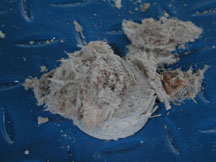
This is what hydraulic erosion does to balsa which is reduced to a slurry of fibers.
Water migration is aided, particularly on hull bottoms, by the forces of water against the hull. This creates a pumping, hydraulic effect that serves to distribute water throughout the core.
If the void areas in the core are completely water-filled, the hydraulic action will become so powerful that it will reduce the core to a slurry of fibers or mush. This, then, is a total catastrophic core failure after which the skins are likely to fracture.
Vacuum bagging goes a long way toward eliminating the water transmission problem, even if water does enter the core at some point. This is because the vacuum forces resin down into the kerfs thereby blocking them as a means of, or channel for, water migration.
Thus, water entry into the core becomes very unlikely to migrate or spread. Yes, it can result in deterioration of the core at the point of entry, but the area is likely to remain small and unlikely to threaten the entire hull as with a non vacuumed hull.
Balsa has been shown to break down through three different mechanisms, hydraulic erosion, fungal degradation or rot, and a lesser known and understood form of corrosion. As oxygen starvation can cause severe corrosion of metals, it can also cause corrosion of wood.
The acid destruction of paper has long been a problem for historians and anthropologists as natural acids cause paper to self destruct. Paper, of course, is made from wood cellulose, both of which are vulnerable to acidic destruction.
Our investigations have shown that balsa cores in hulls are most often degraded by means of closed cell corrosion, caused by the lack of oxygen within the core, causing the water to become acidic.
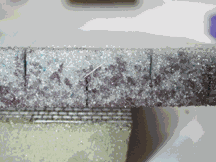
If you didn't think that foams can absorb water, check out this test sample that was placed in a tray of colored water for five minutes. Notice how the water climbs and creeps along the surface.
What caused the degradation of the balsa is readily assessed by its color. Fungal attack will turn the wood dark brown or black whereas corrosion causes little color change, or turning it only a slightly darker shade than its original color. Hydraulic erosion turns the wood into a slurry of loose fibers with almost no color change, unless accompanied by fungi.
Can this same type of acidic corrosion affect foam cores? The anecdotal evidence so far suggests that it can, although I have not seen any recent examples.
Many formulations of polyester are vulnerable to corrosion, but most foams today are PVC based and so far have not been shown to be particularly vulnerable. Ultimately, it’s only going to be the test of time in application that will prove the point, for the fact is that we do not yet know.
Foam core materials have been improving in recent years, becoming stronger with better cleavage strength. One product of noticeably improved properties is ATC Corecell on which we have done some limited testing.
One of its virtues, besides improved strength, is its reduced tendency to transmit water along its surface via the capillary effect. Testing with Kledgecell and several other types revealed that when placed in a tray of water, the water would creep along the surface of the material over considerable lengths.
This ability to migrate water along its surface is troubling and appears to be caused by the size and shape of the cells that promotes capillary effect much the same as wood cells do. Corecell produced almost an almost zero creep rate.
The Prospects for Balsa
Based on its historical performance, balsa has many admirable properties but it should not used unless in conjunction with vacuum bagging.
Labor costs today are so high that it cannot be used reliably with normal hand lay up operations, plus there are too many people designing boats today who are utterly ignorant of proper design and lay up techniques.
A fairly large number of yachts have been built of vacuum bagged balsa core (mainly custom or semi custom boats) that it can be reliably stated that vacuum bagging in conjunction with proper design will preclude the severe problems that have occurred of late.
However, a new generation of foams may ultimately render balsa obsolete and not the best choice of materials.
Coremat
Coremat is a proprietary product that is made up of a thin sheet of fibrous material that resembles the absorbent material we see at the bottom of packaged fresh meat.
It is very absorbent of resin and when wetted out properly makes for a very strong laminate and has been in use for about twenty years. The saturated dimensions are only a few millimeters.
We know of no known problems with this material when properly utilized. Contrary to what we expected, our testing of it indicates a notable lack of a tendency to absorb water even when submerged exposed.
This material has its widest application in smaller boat hulls and is rarely found in larger boat hulls.
It is not normally used in conjunction with any other type of core material. Delamination occurring with the use of this material is unknown to us.
The material is sufficiently porous that it will prevent a moisture meter from reading water through a laminate containing the material, even when placed in a tray of water.
Neither does the material show any tendency to wick water through it when the edges are exposed to water. Coremat seems to be one of the unrecognized success stories of the boat building materials industry.
Putty or Spray Cores
Very little is known about putty or spray cores. In fact, when we query surveyors about what they know of it we find that most aren’t even aware of its existence.
Putty cores are usually a polyester paste that is sprayed into a mold after the outer skins have been laid in, used mainly in small boats up to about thirty feet. The thickness of the putty is usually about 3/16" or slightly less and often comprises the major part of the hull thickness, and is used mainly on the hull sides.
In many instances we have found that the putty comprises over 50% of the hull thickness. Of the half-dozen samples we obtained of the material from broken up boats, we found two problems: (1) the material is universally weak and, (2) it exhibited adhesion problems.
We have had at least five cases of massive delamination in addition to what was found with hurricane damaged boats where some hull sides became completely separated.
However, the material has not yet shown any tendency to water absorption, probably because it is not used on bottoms.
Summary
Moisture meters can be used to reliably determine if hull cores are wet, but not, as surveyors expect from the outside of the hull.
The only reliable method is from the inside of the hull. The surveyor will need to make certain that the inner skin is dry and has not been recently submerged, areas such as the bilge, and any other area that may trap and hold water, such as outboard of stringers, even if it presently appears dry. The presence of water stains will usually tell the story.
Moisture meters can be used reliably anywhere from about a foot above the water line, including on decks shortly after a rain, so long as the surface is outwardly dry. Care should be taken to be sure that there is not a residue of salt on the surface. If there is, use a slightly damp cloth to clean it.
Our tests also show that the meter can even work on some non skid deck surfaces such as the leveled diamond pattern, although clearly the reliability of such readings is going to be somewhat reduced.
The meter is most reliable in the hands of a person who experiments with it and carefully considers what he’s doing.
It is least reliable in the hands of a person who thinks that it always produces infallible results. The reason that it does not is because we subject the instrument to limitless varying conditions for which there are no absolute answers. In other words, it takes part science and part skill.
When reporting meter readings the surveyor should identify the type of meter he is using. He should also avoid reporting numbers as a percent because that is inaccurate. It is OK to say that readings were, for example, 24 points on the Trammex scale, but do not express it as a percent.
Posted June 13, 2004




 Visit davidpascoe.com for his power boat books




David Pascoe is a second generation marine surveyor in his family who began his surveying career at age 16 as an apprentice in 1965 as the era of wooden boats was drawing to a close.
Certified by the National Association of Marine Surveyors in 1972, he has conducted over 5,000 pre purchase surveys in addition to having conducted hundreds of boating accident investigations, including fires, sinkings, hull failures and machinery failure analysis.
Over forty years of knowledge and experience are brought to bear in following books. David Pascoe is the author of:
In addition to readers in the United States, boaters and boat industry professionals worldwide from nearly 80 countries have purchased David Pascoe's books, since introduction of his first book in 2001.
In 2012, David Pascoe has retired from marine surveying business at age 65.
On November 23rd, 2018, David Pascoe has passed away at age 71.
Biography - Long version