



My Wet Hull Won't Dry
The 8 Grand Conundrum
by David Pascoe
People with boats undergoing blister repairs often write us to say, "My boat has been drying out for six months now, and it still will not dry. The moisture meter readings are still as high as ever."
"Dry Out" Not Drying
The usual procedure is to just let the boat sit and "dry out" naturally by a process of evaporation. Still others are erecting tents and what not and installing heaters or dehumidifiers to try to accelerate the process. And still they report that it's not "drying."
No, it's not drying. And the reason why is a very simple one. The wetness you are attempting to dry is not water, but something else. In many cases, it can sit there forever and never go away.
Reason Why Hull Won't Dry
You can prove this for yourself by performing a simple test. Collect some fluid samples from blisters on any boat. Rupture the blister with a sharp knife point, then press against it and let it spray into an empty film canister. Then place droplets of the sample on a piece of clean metal or glass. Take it home and put it in a cool, dry place for two weeks.
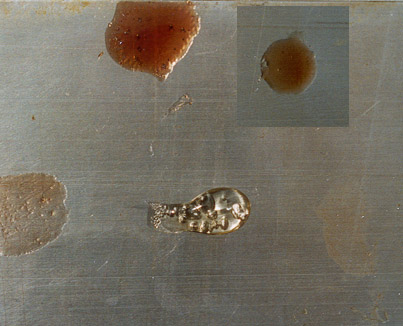
These are samples of blister fluid after 2 weeks of air drying.
The three at top and right are hardened to the touch and have shown almost no shrinkage due to evaporation.
The large one at the tops is roughly 2mm in depth. The volume of fluid placed on the plate remained essentially the same.
Water has been added to the sample on the left. Note that it has dissolved completely, dried up and left the residue spread around.
The one at bottom center developed those large bubbles when placed in the sun. The one at the top also developed bubbles, but most of them dissolved after removal from sunlight.
When you return to your samples you will find that it has not evaporated, but has hardened into a droplet of near solid clear plastic with no detectable loss in volume or size. It may remain somewhat sticky, or it may fully harden to the touch.
If you now take that sample and put it outside in very damp or humid weather, you will find that it will soften up again. In other words, that material is hydroscopic and will absorb water right out of the atmosphere.
Now add a drop of water to the sample. Surprise! It will dissolve the solidified material very quickly. And if you take a moisture meter reading of the solidified material on a piece of glass, you'll get a high reading.
How to Dry Wet Hull
What you will have just demonstrated is the reason why your hull won't dry, and the answer on how to dry it. What is migrating out of your exposed hull laminate is a combination of hydrolyzed polyester resin, salts and other chemicals.
These sometimes migrate to the surface where exposure to air causes the fluid to naturally cure. But it doesn't go away. It just stays there alternately curing and softening with the changing atmospheric conditions. On a rainy day, it will probably become nearly fluid. After a few days of cool, dry weather it cures again.
Now that you know this gook is water soluble, you know how to get rid of it. Yep, just take a hose and wash it away! But while the hull is wet, be sure to give it about 30 minutes to completely dissolve.
"But won't I just be making my hull wetter by putting water on it?"
Yes, but only temporarily. We've already discovered that the fluid weeping out of the hull is NOT water and will NOT evaporate. As you know, water evaporates very quickly, and the water you use to rinse the hull down will too.
Wet the entire hull down and keep it wet for about thirty minutes. Then come back with a hose nozzle and spray it with a bit of pressure to remove the remaining traces since some of this stuff may take longer to dissolve.
On some boats you will actually see the accumulations of fluid on the surface, most often in isolated spots that are little weep holes. This indicates that there is likely a concentration of fluid under the surface and it is finding its way to the surface through a capillary.
Most likely you will need to wash the hull down at least three times depending on the condition of the hull.
In any case, this will greatly advance the "drying" process and your meter readings should begin to drop significantly, only to start rising again.
Take note of the fact that some hulls actually do have plain old water saturation with only very small traces of hydrolyzed resin.
In this case, you may find that the hull starts to dry quickly, but then an odd thing happens. The readings start to rise again. If that happens, it's because the water is migrating to the surface, and then leaving deposits of dissolved material as it evaporates, possibly including salt (which is also hydroscopic), so that the readings again start to rise. Again, simply wash down the hull with water to remove it. If you have any doubts about this, then only try a test area to see if it really works.
Also, if you are located anywhere near the ocean, make certain that wind-blown salt is not accumulating on your hull. Salt is hydroscopic and will condense water out of the atmosphere. If you are anywhere near a shore with surf, keep in mind that salt can easily be blown inland several miles, and it collects on everything. It will, for example, accumulate on the topsides of your boat, and then be washed downwards by rain.
Keep in mind that hydrolyzed resin may or may not contain other chemicals such as salt.
This means that there is no consistency to how a moisture meter will read the stuff. Plastic and glass fibers are not conductive, and since moisture meters operate by metering conductivity, it will all depend on the water and salt content of the hydrolyzed resin. It may be zero or it may be 30.
But there is one thing you can be sure of, which is that if the hydrolyzed resin is not removed from the laminate, it will once again absorb water and start the blistering process all over again and your expensive blister repair job will fail. No, despite all the hype about "barrier coats," there isn't anything that is going to keep water out of the hull laminate completely.
Blister Repairs - Real Cure for "Boat Pox"?
If you haven't already started a repair job, but are thinking about it, we'd strongly suggest you stop to consider whether it is really possible to cure "boat pox." Shown below is the disclaimer from a 3M product that is sold as a blister repair material.
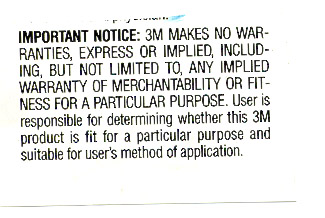
This product is advertised in boating magazines as a repair for blisters. It does not say so directly, but rather suggests that it is. Then, in small print on these cans of extremely expensive materials, we read that the manufacturer is telling us that the stuff is not intended for ANY particular purpose. It is up to YOU to decide if this stuff is any good for anything because 3M does not imply or warrant that it is.
So, if you wonder why we tend to be a bit cynical about the booming business of blister repair, there's graphic reason why.
Posted June 27, 1999

 Visit davidpascoe.com for his power boat books
 David Pascoe - Biography


David Pascoe is a second generation marine surveyor in his family who began his surveying career at age 16 as an apprentice in 1965 as the era of wooden boats was drawing to a close.
Certified by the National Association of Marine Surveyors in 1972, he has conducted over 5,000 pre purchase surveys in addition to having conducted hundreds of boating accident investigations, including fires, sinkings, hull failures and machinery failure analysis.
Over forty years of knowledge and experience are brought to bear in following books. David Pascoe is the author of:
In addition to readers in the United States, boaters and boat industry professionals worldwide from nearly 80 countries have purchased David Pascoe's books, since introduction of his first book in 2001.
In 2012, David Pascoe has retired from marine surveying business at age 65.
On November 23rd, 2018, David Pascoe has passed away at age 71.
Biography - Long version